

If there’s something I’ve never fully conquered, it’s emotional eating.
I’m definitely better at it these days, but all it takes is one stressful day at work or a slightly darker thought spiral (hello, perimenopause), and suddenly food is all I can think about. Not just any food - a lot of food, the kind I usually wouldn’t even be tempted by.
This feels different from hormonal hunger. It’s stronger, more insistent, and I can feel it overtaking my sense of agency.
Here’s the frustrating part: I know I’m not hungry. I’ve eaten enough. I know exactly which emotions are driving this urge. So the usual advice about “identifying what you’re really feeling” doesn’t help - I already know. I know why I’m upset and I know food won’t actually help.
But in that moment, all I want is the comforting feeling of sitting down and eating whatever appeals to me until the urgency goes away.
Sometimes I try the usual tactics. Drink water. Eat vegetables. Try something sweet to answer the craving. When true emotional hunger hits, none of it helps.
What makes it even more frustrating? I’m in a perfect dialogue with myself the entire time. I know I’m not hungry. I know I’ll regret it. I’m crystal clear that what I want is just to eat until I calm down. And yet, I am not able to reroute and stop the urge.
Years ago, these episodes ended in proper binges. These days it’s usually just eating foods I wouldn’t normally choose, in quantities I wouldn’t normally eat, with full awareness of what I’m doing. But until I actually eat as much as I want, it won’t calm down.
For someone who’s come a long way in her relationship with food, it’s a very frustrating experience.

In my last post about finding motivation when you have none, I wrote about how you need to rewire neural pathways and create new “paths of least resistance” for your brain. The more consistently you engage in healthier behaviors, the more your brain learns they’re safe and normal, and the less resistance you feel.
Then a reader commented:
“How come the brain still wants to revert back to old ‘undesirable’ habits, even after years of new ‘desirable’ behaviors?”
That question hit home because it touches exactly on my emotional eating experience.
I’ve been eating well and “in control” of my emotional eating for long stretches. But from time to time, if the stress trigger is strong enough, I fall (almost) right back to where I was. These days it’s not as long - I’m usually back on track the next day. Even when I fall down the chute, I don’t fall as deep.
And that made me think:
What if emotional eating is, in part, a habit problem?
Maybe you’ve spent months or years eating in a way that serves you. You’ve built new habits. You understand your triggers. You’ve learned to recognize real hunger from emotional hunger. You’ve done the work.
And yet it still happens.
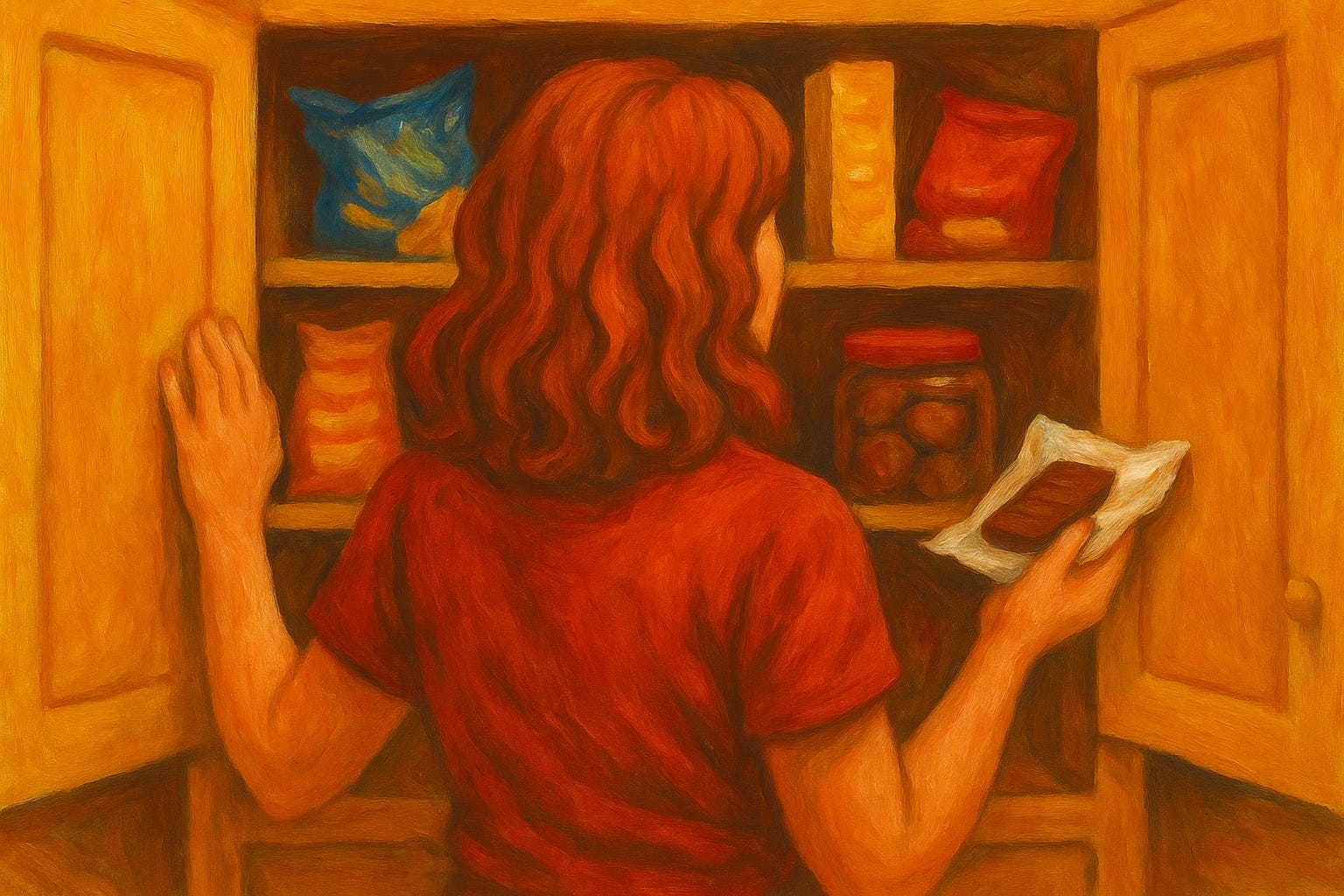
A terrible day at work. A fight with your partner. Bad news that knocks you sideways. And suddenly you’re standing in your kitchen with your hand in the snack cupboard, eating in that familiar numb way you thought you’d left behind.
“How am I back here? I’ve been doing this for years. I thought I’d changed. Why is the pull still so strong?”
Why Old Patterns Never Really Leave
When I wrote about creating new habits, I explained how we build new neural pathways - new easy-to-follow routes that are more helpful than our old choices. You’ve done the work. You’ve created new habits. You’ve “broken” the old ones. Done, right?
Not quite.
Science tells us you never really erase old behaviors. You build new pathways alongside them.
Every habit you’ve ever formed created a neural pathway in your brain - a route from trigger to behavior to reward. The more you repeated it, the stronger and more automatic it became.
If you spent years being stressed and reaching for food, and that food provided comfort or distraction, your brain logged it: Stress → Eat → Relief. Do that enough times, and you’ve got a superhighway. Fast, efficient, highly automatic.
When you started adopting healthier coping strategies - walking when stressed, calling a friend, inspecting your emotions - you created a new pathway. With repetition, it got stronger too.
But the old pathway didn’t disappear. It just became dormant.
Neuroscientists call this “extinction,” not “erasure.” Think of it like an overgrown forest path. It’s no longer maintained but it hasn’t been bulldozed over. The brain layers new learning on top of old learning. The new learning inhibits the old, but doesn’t wipe it out.
From an evolutionary standpoint, this makes sense. Forgetting patterns entirely would be risky. If a once-dangerous or rewarding situation returns, your brain can react without relearning from scratch. It saves time, increases survival chances, uses less energy.
The problem? Our survival brain doesn’t align with who we want to be. Finishing that bag of Doritos in one sitting because of a work argument isn’t helping us reach our goals.
Which is why, with the right context and strong enough triggers, even after years of healthier behavior, the old pattern can suddenly resurface.
Why Stress Triggers Emotional Eating
There’s a reason old emotional eating habits resurface under stress. Why you can handle boredom fine but lose all control when emotionally activated.
When we’re stressed or overwhelmed, our prefrontal cortex goes offline.
The prefrontal cortex - responsible for executive function, decision-making, self-regulation - is what helps you pause, consider options, and choose behaviors that align with your values. But it’s resource-intensive. It requires energy and cognitive capacity.
Under significant stress, exhaustion, cognitive overload, or emotional overwhelm, it doesn’t have the resources to stay engaged. It shut down, or at least the light dims.
When that happens, your brain defaults to autopilot. Autopilot runs on the most automatic, deeply ingrained patterns - the ones requiring the least cognitive effort.
Often, those are the older patterns. The ones you built first. The ones you repeated for years before changing.
This is why you can do brilliantly for months, then have one terrible day and find yourself eating your feelings exactly like you used to.
Not your weakness. Not a failure. Just your brain operating in energy conservation mode, reaching for the most automatic pattern.
The old pathway is still there. Under stress, it becomes the path of least resistance again.
But what if, like me, this isn’t just happening when you’re overwhelmed? What if you’re walking eyes-wide-open into emotional eating, knowing it’s happening but unable to stop?
The Context Of Your Emotional Eating Matters
Our brain doesn’t learn behaviors in isolation. It learns them in context - tied to specific situations, environments, emotions and triggers.
Maybe you used to emotionally eat late at night when lonely. Or after arguments. Or when overwhelmed by work. Your brain encoded not just the eating behavior, but the entire context.
When you encounter a similar context, even years later, those cues can reactivate the old pathway. Your brain recognizes the situation: “Oh, I know what we do here.”
This is especially true for emotional triggers. If old eating habits were tied to specific feelings - anxiety, loneliness, anger, overwhelm - and eating provided genuine relief, that emotional association remains encoded in your limbic system.
The emotional trigger doesn’t just bring back the memory. It reignites the urge, even after years of inactivity.
The Power of Emotional Memory
There’s something particularly powerful about habits that provided emotional relief. When you repeatedly turned to food during stress and it delivered comfort - even temporary comfort - your limbic system encoded not just the behavior, but the emotional reward. This is different from other types of memory. It’s visceral, automatic, and incredibly persistent.
Your limbic system remembers how good that relief felt. The warmth of being soothed. The numbing of difficult emotions. The distraction from pain. These aren’t just memories you can think about - they’re embodied experiences your brain can almost recreate just by encountering the trigger.
This is why an emotional trigger doesn’t just remind you that you used to eat when stressed. It can make you feel the craving, the pull, the need for that specific type of relief - as if your body remembers the comfort before you’ve even taken a bite. The stronger the emotional reward was originally, the more powerfully it’s encoded, and the more easily it can be reactivated.
This explains why you handle everyday stress fine with new coping strategies, but a specific type of stress - one that feels similar to a habit you used to face - can trigger the old response so powerfully.
When It Feels Like You’re Back at Square One (But You’re Not)
If you slip back into an old habit after not doing it for ages, it often comes back faster and stronger than expected. This is known as the “savings effect” in neuroscience.
Even dormant behaviors can return more quickly than they were originally learned. Your brain says “Oh, I remember this” and rapidly reactivates those connections.
This can feel devastating. Like you’ve lost years of progress overnight.
But you haven’t. That pathway was always there, inactive, but not gone. Reactivating it is faster than building new from scratch.
Here’s the encouraging part: Your new, healthier pathways are also still there. Still strong.
Getting back on track will happen much faster than when you first built those habits. You’re not starting over. You’re redirecting to a path you know well.
This is why those episodes feel shorter, less painful, more controllable the longer you maintain good habits.
This Isn’t About Your Character
I want to pause here and address what I know I’ve felt and what you might be feeling: shame, frustration, disappointment, maybe despair.
“I should be past this.” “I thought I’d changed.” “All that work for nothing.”
Understanding that old neural pathways remain dormant but don’t disappear isn’t depressing. It’s liberating.
You’re not broken. Your brain is working exactly as designed - conserving patterns that were once adaptive, even if they no longer serve you.
You haven’t lost your progress. The new pathways are still there, still strong, still your default under normal conditions.
This is normal. Every single person who’s changed a deeply ingrained habit deals with this. The old pattern emerging under stress doesn’t mean failure. It means you’re human.
It gets easier every time. Each time you redirect back to healthier behaviors, you strengthen those pathways and prove you can get back on track.
The goal was never to make the old pathway disappear completely. That’s impossible. The goal is making your new pathway so well-maintained that it remains your automatic choice most of the time - even under stress.
Practical Strategies, or What Can You Do About It?
So what do you do with this information?
Shift From Judgment to Curiosity
The fastest way to strengthen unwanted behavior is judging yourself harshly for it.
Shame yourself for emotional eating, and you create more distress - which triggers more emotional eating. You’re literally feeding the cycle.
Instead, practice recognition without judgment.
Reframe from “I’m broken” to “My brain is doing its job.” This lets you observe without adding shame to stress.
Then get curious: “I’m reaching for food even though I’m not hungry. What’s happening? What am I feeling? What triggered this? What do I actually need right now?”
Curiosity interrupts the automatic pattern. It brings your prefrontal cortex back online - the part that can observe, reflect, choose.
Judgment collapses the space between trigger and behavior. Curiosity creates it.
When you notice the urge, get curious about the urge itself. What does it feel like in your body? Where do you feel it? What’s it trying to tell you?
You don’t have to act on it or suppress it. Just observe with genuine curiosity. Often the urge shifts or lessens with this gentle awareness.
Map Your Patterns and Build Circuit Breakers
Get specific about when the old pattern resurfaces. Particular type of stress? Time of day? Specific emotions? Environmental cues?
Once you identify high-risk contexts, prepare. Not with willpower, but with circuit breakers - something that interrupts the automatic sequence.
If your pattern is: Stressful day → Walk in door → Head to kitchen → Eat, interrupt at any point.
Change clothes immediately. Take a 10-minute walk before entering. Create a decompression ritual without food. Text a friend. Keep trigger foods out during high-stress periods.
The circuit breaker doesn’t need to be perfect. It just needs to create enough pause for your prefrontal cortex to come back online.
Pay Attention to How It Actually Feels
This strategy from Dr. Judson Brewer’s work about mindfulness is counterintuitive but powerful: instead of trying not to emotionally eat, pay close attention to how you actually feel when you do.
Without judgment, with curiosity.
Notice how food tastes when eating emotionally versus when hungry. Often it’s not as satisfying as your brain predicted. Notice the uncomfortable fullness, bloated stomach, sluggish heaviness, nausea.
And crucially: notice how you feel the next day. The food hangover. Brain fog. Physical discomfort. The emotional aftermath - guilt, disappointment, that “ugh” feeling.
Your brain engages in emotional eating because it predicts: “This will make us feel better.” But when you mindfully observe the actual experience - not just the first bites, but the whole sequence and aftermath - you give your brain updated data.
“We thought this would provide relief, but actually, we feel worse.”
Over time, this awareness naturally weakens the behavior. Not through willpower but through your brain updating its prediction. When your brain learns emotional eating doesn’t deliver the promised relief, the urge diminishes.
The practice isn’t stopping yourself. It’s being fully present when it happens. Curiosity, not judgment. Observation, not shame.
Maintain Your Desirable Habits and Recover Quickly
Your new healthy coping strategies need maintenance, not just one-time building. They’re your default under normal conditions, but they need regular practice - especially during low-stress times - so they’re accessible when stress hits.
Use healthy coping strategies even when you don’t “need” them. Practice stress management when you’re not stressed. Keep the new pathway strong.
Think of maintaining a trail. Walk it occasionally, it grows over. Walk it regularly, it stays clear and easy to follow even in difficult conditions.
When you do slip, the most important thing is getting back to healthier behaviors immediately. Not tomorrow. Not Monday. The very next choice.
One episode after months doesn’t undo progress. But shame spiraling into “I’ve already ruined it” thinking keeps you in the old pattern longer.
Your new pathway is still there. Strong. Waiting. Get back on it right away. You’ll reinforce that you can recover quickly and build resilience.
Zooming Out: What Really Matters
Your brain has two pathways. The new one - healthier coping strategies - is your default now. That’s real progress. Months or years of work paying off.
But the old pathway can still be accessed under certain conditions: high stress, familiar triggers, specific contexts your brain associates with old behavior.
This doesn’t mean you haven’t changed. It means you’re human.
Every time you choose the new pathway - especially after using the old one - you strengthen the new and weaken the old pathway’s pull. You teach your brain the old pattern isn’t needed.
Over time, even under stress, the new pathway becomes more automatic. The gap between slipping and getting back on track gets shorter. The old pattern loses power.
But it probably won’t disappear completely. And that’s okay.
You’re not trying to become someone who never feels the pull of emotional eating. You’re becoming someone who recognizes it, understands it, has strategies for it, and gets back on track quickly.
Think of it as mastering the art of emotions and food.
In Practice
Next time you find yourself reaching for food when stressed - after weeks or months or years of not doing it - try something different.
Instead of shame, try curiosity.
Notice it. Don’t judge it. Learn from it.
Then make your next choice aligned with who you are now, not who you were then.
Your new pathway is still there. Your progress is still real. Your brain just needed reminding.
Each time you redirect, you get better at it. Faster. More confident in your ability to recover.
And if you can’t redirect just eat and observe how it makes you feel, the good, but more importantly the bad. Create a new negative association with the behaviour.
This is how you build a sustainable relationship with food and emotions. Not by never struggling. But by knowing how to find your way back when you do.
🌸Thanks for reading! I’m building this space for women who want the knowledge and inspiration for healthy, sustainable and sane weight loss, maintained for life.
💭Tell me in the comments what clicked for you in this post or share any questions or topics you’d love to read more about.
💌Forward this post to someone who needs some inspiration and support on their journey.

Thanks Adi, it is very recognizable. I usually fall into old pathways when bored or without direction. What I wonder about in this regard is the following. In holidays I usually let go a bit and choose to walk some old pathways (eating unhealthy stuff and bigger amounts) and thats ok. I go back to newer, better pathways as soon as back. It works for me. However, I look forward to these times. Not just because its holiday and because its fun but also because my brain seems to crave the unhealthy food and the unhealthy amounts even months in advance. While I know it is not going to make me happy and I know it is not good for me. It is like a delayed urge….why doesn’t this desire to overeat (even when I know it is months away) leave me?