

I’ve been moving through a rough patch lately. The things that usually feel energising and satisfying have started to feel a bit flat. The movement practices that normally lift me up suddenly feel like routines I have to coax myself through. I think most of us have stretches like this, where the spark dims and everything takes a little more effort than it should.
And yet, even in this dip, I still manage to show up for the basics. I take my daily walks. I get some form of resistance training in. I mostly nourish myself in the way I know helps me feel grounded. Let’s make it very clear: none of it is perfect. The walks are slower and more about clearing my head or catching up with a friend. The gym often feels like a simple check box. My eating gets a bit looser, and I lean on food for comfort more than I’d like.
But even with all that, the core habits seem to hold. Not because of discipline, guilt, or forcing myself into shoulds. Because someway during this journey I started seeing myself differently. That slowly acquired identity gives shape to my choices, even when my motivation wanes. Somewhere on the journey I adopted the view that every small action, no matter how little, how ‘inadequate’, or lacking short of what ‘it should be’ is a vote for the person I’m in the process of becoming. And that, more than anything, is why some habits survive the hard seasons whilst others fall away.
I’m not sharing this to brag. God knows it’s still a struggle, and it was never ever easy in the past (it still isn’t). I’m sharing it because, after years of yo-yo dieting, of losing then gaining the weight, after adopting new habits, only to at some point give up and slowly return to square one (or worse) whenever life got hard, two things finally made a difference: prioritising consistency over perfection and building a new identity, one habit at a time.

Psychology has a name for this: identity based motivation. And understanding it has changed how I approach not just weight loss, but any behaviour change I want to sustain.
Most of us start a health or weight loss journey with a target. Lose 20 pounds, lose 5 kg. Drop two sizes. Fit into the jeans. Look great at that wedding. Hit a healthier cholesterol number. We have a clear ‘after’ picture and use it to fuel our efforts.
Research calls this outcome based motivation. It makes sense on paper, but studies show it has a hidden flaw. When your drive is tied to a specific result, your motivation can become shaky the moment that result feels uncertain. Some people can push through regardless, but for many of us, the second a challenge appears, the goal feels further away. Progress slows. You might hit a plateau. Or life becomes more stressful and your emotional state changes. Life shifts and your routine becomes harder to maintain. Suddenly the effort feels pointless and old habits feel easier.
I’ve been there more times than I can count. You work hard, eat well, move your body, and for a while it clicks. Then, out of nowhere, it doesn’t. The scale won’t budge, the routine feels heavy, and the distance between where you are and where you want to be feels wider, not narrower. That’s usually when we quit.
And it’s not just anecdotal. Research consistently shows that people motivated mainly by weight loss, weight control or fluctuating emotions (today I am highly motivated and ready to change! Tomorrow I am depressed, tired and couldn’t care less) have poorer adherence to their health plans. Even when their health markers improve, or they see progress, they tend to abandon the process because they haven’t hit the target yet. As humans, we tend to ignore progress and focus only on the gap, where we fell short.
There’s another issue with relying on goals and willpower: it’s exhausting. Change requires both motivation and cognitive resources. Motivation is the desire to change, the will. Executive function is the mental capacity to plan and follow through, the way. Both are limited, and both drop dramatically when you’re stressed, tired, overworked, or overwhelmed. If you’re a woman over 40 juggling everything, that means... most of the time.
Surely, there must be a better way. And studies show there is: identity-based motivation.
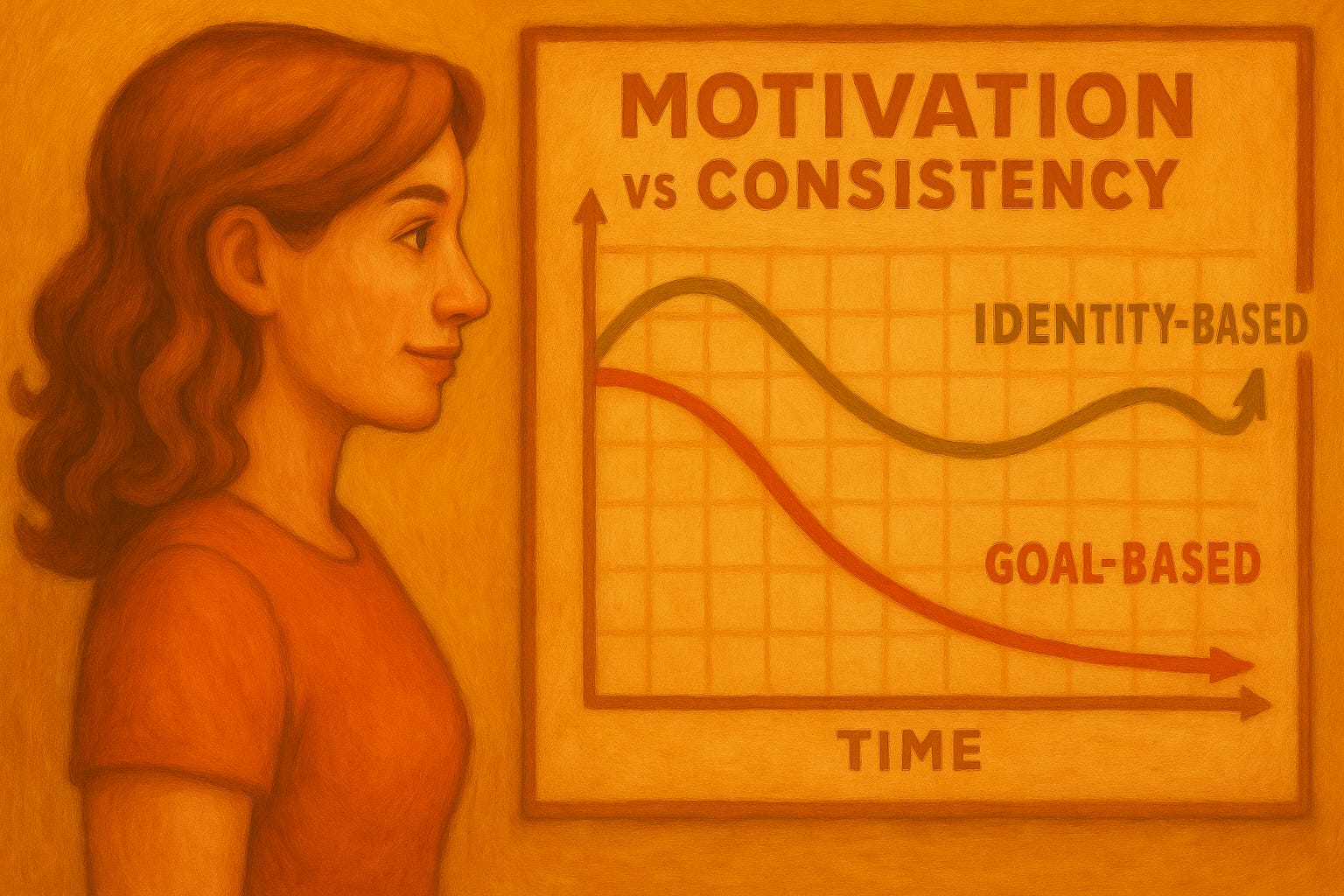
Identity-based motivation flips the question from “What do I want to achieve?” to “Who do I want to become?”
Instead of “I want to lose 20 pounds,” you shift to “I am someone who takes care of my health.”
Instead of “I need to exercise more,” you move towards “I am a strong, capable woman who invests in her body.”
This isn’t a woo-woo mantra or a motivational gimmick to get you excited to take action. It has been shown to genuinely change how your brain processes decisions.
When a specific identity becomes active and present in your brain, it shapes the frameworks your brain uses to interpret the world around it. If you identify as someone who moves regularly, choices that fit that identity feel natural. The identity becomes a filter that influences what you notice, how you interpret situations, and the actions that feel aligned with who you are.
If you see yourself as someone who nourishes her body with food that supports her energy and wellbeing, choosing a protein-rich breakfast instead of a pastry isn’t a battle with willpower. It’s simply consistent with who you are. The decision becomes easier, faster, and over time, automatic.
Again, it doesn’t mean from now on you won’t struggle and a chocolate croissant will start feeling revolting, but it means that a lot of the time, and more and more the stronger the identity becomes ingrained, it will just be something you just don’t do. Part of who you are. It will move from a having to fight yourself every single time you are faced with a pastry or the need to go to the gym, to being the occasional off day struggle or a specific cravings, you will be happy to indulge (or resist).
Identity-Based Motivation theory shows that when an identity is salient (actively present in your mind), your brain starts to rely on cognitive shortcuts rather than slow deliberation. Your brain understands, “This is who I am, so this is what I do,” and moves on.
Research on habits and self-concept supports this. When behaviours become integrated into your sense of self, the brain processes them more efficiently. The decision pathway becomes faster and requires less conscious deliberation. You’re not fighting against your default state - you’re operating from it.
So what does this mean for us? A smoother, less exhausting path. One that doesn’t rely on constant pep talks and willpower highs and instead goes much more smoothly and effortlessly.
Why Identity Based Motivation Works Better Than Goal-Based Motivation
Having goals is great and i am not suggesting ignoring them completely. But i would recommend layering them on top of the more fundamental adopted identity. And here is why:
1. Identity Based Motivation Creates Self-Sustaining Motivation
When a behaviour is linked to identity, your motivation becomes internal. You’re not exercising to hit a number or eating well to meet a short-term target. You’re doing it because it reflects who you are.
This kind of motivation persists through plateaus, setbacks, holidays, busy seasons, and bad weeks. Your identity doesn’t vanish just because the scale hasn’t moved.
Studies on dietary adherence found that people with high self-efficacy (the belief they can carry out their eating pattern daily and be successful at it) and strong identification with their dietary approach, were the ones who stuck to their habits long-term. Those driven mainly by the wish to lose or maintain their weight, without that sense of capability or identity, were far more likely to abandon their dietary pattern.
2. Identity Based Motivation Reduces the Willpower Tax
When healthy behaviours become part of your self-concept, your brain processes them through something called ‘self-schemas’. These are mental structures that store your core beliefs and behavioural patterns. Research shows that when something fits your self-schema, you process it faster and remember it more strongly. The brain essentially labels it as important and self-relevant.
When it comes to our brain, this efficiency matters. Self-schemas enable what psychologists call preconscious processing - your brain can access and act on this information quickly, without requiring the slow, effortful deliberation that drains your limited executive function. Read this as ‘the endless deliberation of should i go to the gym this morning, or maybe this evening, or is it too cold to go at all, over and over and over”.
This is why, when you identify as someone who exercises, the decision to go doesn’t require a debate. The choice has already been made at the identity level. You’re preserving your cognitive resources for decisions that actually need them. Which translates to an easier, more seamless experience and means you are more likely to persevere.
3. Identity Based Motivation Uses Cognitive Dissonance to Keep You on Track
Humans are wired to seek alignment between beliefs and actions. When they clash, you experience cognitive dissonance - an uncomfortable psychological state that motivates you to resolve the inconsistency.
When your identity is strong, your brain resolves this dissonance by nudging your behaviour back into alignment. If you see yourself as someone who values strength and movement, a week without workouts doesn’t create guilt or self criticism. It brings a subtle inherent sense that something is off. Not a shove, but a quiet internal signal that grows until you realign.
Goal-based motivation doesn’t create that same internal pressure. You can postpone action with “I’ll start Monday” because nothing fundamental about your self-concept is being contradicted, and your brain actually prefers you postpone, because it tends to go for the familiar habits that feel automatic and easy.
The Practical Beauty of Identity Based Motivation
The magic of this, if I can call it magic, is that every aligned action you take becomes evidence for the identity you’re building.
One workout isn’t an attempt to burn the calories from last night’s pizza. It’s a vote for “I am someone who invests in my body.”
One nourishing meal isn’t about making sure I meet my macros today. It’s a vote for “I am someone who takes care of herself.”
No single vote transforms you. But votes accumulate and they form into patterns. And your brain updates its story about who you are. Your identity strengthens, which makes action easier, which strengthens your identity further. It becomes a positive feedback loop.
Research confirms this: The more people engage with consistently performing certain behaviours, the more people infer that these actions are important and integral to who they are. One builds the other. Identity drives consistent action, and consistent action provides self-evidence, which exponentially solidifies the identity. Each behaviour that aligns with your chosen identity becomes increasingly automatic and effortless over time.
What This Looks Like in Real Life
You will still have off weeks. Days where everything feels like maintenance. Walks that feel slow. Workouts that are just boxes ticked, where you go to the gym, but leave half way through. Or you stay the duration doing a half-arsed effort, just to say you did it. You will make less than ideal choices and eat meals that are more indulgent than ideal.
But your consistency will still count. You will know that you are still casting votes. Your actions and behaviours are still reinforcing the identity you’re building.
Some days you’ll want to stay in bed or eat the cake. And sometimes you will. But as your identity becomes stronger, you’ll feel that internal nudge: this isn’t like me. Not guilt. Not shame. Just a gentle reminder of who you’re becoming and it would help you make better choices more often than less optimal ones. The balance will shift.
And that identity is what will help you keep showing up, even when motivation suddenly evaporates. It’s a sort of resilience that identity-based motivation provides.
These days, I think of it as a buffer between a short tough period when I am less motivated and giving up completely going back to old habits or ‘all out’. Yes, my choices might not be taking me forward, I might not be losing weight or maintaining it or even really building new strength or achieving personal records. Heck, maybe i am gaining weight and losing muscle, for a while. But Identity motivation keeps the slope moderate instead of slippery. I might slip a little bit, but I won’t go all the way down the slide.
And the real magic is that when you maintain your non negotiables, you go for your walks, you train, you keep focusing on nourishing your body - even if you are not optimal in your choices, it creates a movement forward. It makes you feel good, it creates motivation and one morning you wake up and you have the energy to do a little bit more. You go for a walk but feel good enough to jog. You go to the gym to get it over with, and suddenly you have an amazing session where you feel inspired to do more. Your motivation builds right back up.
Where to Start
If this resonates, start with a simple question: when I imagine my future self, Who do I want to become?
Not what do you want to lose, by when etc. Who do you want to be?
I am someone who values strength. Nourishes my body well. Moves regularly. Takes care of my health. Respects my body’s needs.
Use the present tense. You’re not waiting to become this person after the weight comes off. You become this person through your daily behaviours and votes.
Then choose small, doable habits that support that identity. Each habit is evidence. Evidence becomes identity. Identity becomes consistency. Before you know it, it’s just something you do. Almost, dare I say, easy and effortless. Certainly easier and requiring less struggle than before.
I will do a separate post on what the science says about how to build successful identity-based habits, but for now:
Who do you see yourself as? Who do you want to become?
That’s where sustainable change truly begins.