

I don’t believe in meal plans. At least not the kind someone else gives you.
I believe in empowering you to understand how to structure your meals. Because once you have that knowledge, you can create your own approach - for weight loss, maintenance, or just health - for life.
Knowing how to build your plate doesn’t mean you’ll always be perfect. It means you’ll have the confidence and understanding of what levers to pull, how to cover the basics for your health, and how to reach and maintain your happy weight.
Once you internalise and practise these guidelines, you’ll be able to build the best meals for you. No matter where you are, no matter what’s available, and with an understanding of what you might need to make up for later.
Let’s start with the single overarching principle of this framework:
Optimise Nutrient Density to Volume
You’re aiming to consume the most nutrients, for the lowest number of calories, with the most food on your plate.
Let me break this down into its three components:
Consume the Most Nutrients
Our aim is to get a high quantity and variety of quality nutrients from the food we’re eating. When your body gets the nutrients it needs, you’ll be healthy, well-functioning, and feel strong - both mentally and physically.
When it comes to satiety, we know that when the body is missing specific nutrients, it will keep driving you to eat until those needs are met. (I’ve talked about the protein leverage hypothesis here - your body will keep you eating until it gets enough protein, even if that means consuming excess calories from other sources.)
Adequate nutrient intake signals to your body that all its needs are met. No need to eat more. So whichever way you look at it, you want to make sure you’re nourishing your body well.
For the Lowest Amount of Calories
When your aim is to lose or maintain weight, calories matter. There’s no escaping it.
You can optimise how your body burns or stores fat. You can balance your hormones. All of these things are important. But at the end of the day, weight loss comes down to a simple equation - burning more calories than you consume.
Physiologically, the amount of calories we consume depends mostly on our level of satiety - how full and satisfied we feel. If we ignore emotional eating, social eating, and other reasons we eat, in an ideal world we would eat until we’re satisfied, and eat again when we’re hungry.
So the more we can increase satiety and satisfaction from fewer calories, the less we’ll eat, and we’ll maintain or lose weight.
Eat too few calories and don’t optimise for satiety? You’ll be hungry, then ravenous, then will likely end up eating much more than you ever wanted or needed as your body compensates for any deficits.
But find the right balance where you’re satisfied whilst still controlling portions and calories, and you’ve won the game.
This is where we look at the caloric density of foods - how much food you can eat for how many calories - as well as how satisfying different foods are. For example, we know that protein is the most satiating macronutrient. Fibre - found in many carbohydrates - also plays a powerful role in keeping you satisfied.
For the Highest Volume on Your Plate
We want to eat enough food, not just a few bites.
First, because the volume of food we eat is directly related to our levels of satiety. Our stomach has sensors that get activated based on how stretched it is, and these in turn activate satiety hormones. So the volume of food we consume directly impacts how satisfied and full we feel.
This is partially why drinking lots of water helps with satiety and has been shown to reduce calories consumed at meals. The more water you consume with the meal, the more stretched your stomach, and the fuller you feel.
Beyond signalling to your brain that you’ve had enough to eat, psychologically - if volume and quantities have been an issue for you in the past - having a sufficient quantity of food on your plate and in your stomach makes you feel like you’re eating enough, both visibly on the plate and as a psychological reassurance signal.
Research shows that humans tend to consume roughly the same weight of food each day, regardless of how many calories that food contains. We eat until we feel physically full - until our stomach is satisfied - not until we’ve hit a specific calorie target. This is why calorie density matters so much. If you’re going to eat around the same weight of food anyway (let’s say 3-4 pounds per day), you want that food to be packed with nutrients and low in calories. When you optimise for satiety - choosing foods high in protein, fibre, and water content - you’ll consume more nutrients for fewer calories, feel just as satisfied, and naturally create the calorie deficit needed for weight loss. It’s not about eating less food. It’s about eating the right food.
Additional Guidelines That Matter
Prioritise Variety
We want to aim for as much variety as possible in our food, specifically when it comes to plant food sources.
Plant foods are rich in flavonoids and antioxidants, prebiotics (the food that feeds our gut microbes), and support a thriving healthy microbiome. This has a direct proven impact on our health, our ability to lose weight and maintain a healthy weight, our mental health, and so much more.
The recommendation is to include as many as 30 different plant sources each week - some experts would go as high as 50. Generally, the more varied sources, the better, as each contains different micronutrients and supports different gut bacteria.
How do you get that variety? Every source of plant foods counts. Think spices like turmeric, cumin, or paprika - they each count as one different source. A mix of herbs gets you several sources in one sprinkle. Same for seeds, nuts, vegetables, and fruits.
Eat the rainbow and aim for colourful, varied plates. You don’t need much in terms of portion size from each source, but you do need to provide that variety for health.
Stick to Whole Foods as Much as Possible
The topic of processed versus whole foods is complex, but what we know is that processed foods make weight loss significantly harder for a few key reasons.
First, they pack a lot of calories into very little food. You can eat 500 calories of chips in minutes, but you’d have to eat a huge salad, 4 big potatos or several cups of vegetables to reach the same calories. Because they’re engineered to be hyper-palatable - optimised for taste, texture, and reward - they override your body’s normal satiety signals. You end up eating more before your body feels satisfied, and the blood sugar spikes and crashes from refined carbs and low fibre make you hungry again sooner.
In one controlled study, people ate around 500 more calories per day on an ultra-processed diet versus whole foods - even though both diets had the same macronutrients.
Second, processed foods leave your body “overfed but undernourished.” They’re low in the micronutrients and fibre your body needs, which can drive continued cravings as your body searches for what it’s missing. Whole foods give you more nutrition per calorie, support better gut health, stabilise blood sugar, and improve insulin sensitivity - all of which make fat loss easier.
We can’t always avoid processed foods, and the line between processed and partly processed can be blurry. A good rule of thumb: aim for 80% whole foods and keep 20% for your occasional treats, convenience foods, protein powders (if using), or chocolate - also known as, Life.
Include Fermented Foods
Your gut health has a direct impact on your ability to lose weight and keep it off. And one of the simplest ways to support a healthy gut is by incorporating fermented foods into your diet.
Foods like yoghurt, kefir, sauerkraut, kimchi, and miso contain beneficial bacteria that strengthen your gut microbiome. When your gut is balanced, your body regulates digestion better, reduces inflammation, absorbs nutrients more efficiently, and manages blood sugar more effectively - all of which help prevent fat storage and reduce cravings for processed foods.
But fermented foods do more than just improve digestion. They influence the hormones that control your appetite and metabolism. Certain probiotic strains (types of microbes that grow in your gut) can increase production of satiety hormones like GLP-1 and PYY, helping you feel full longer and to naturally eat less. They also improve your body’s insulin response, making fat loss easier.
Including fermented foods in your regular meal routine is a simple, natural way to support both your health and your weight loss goals.
So… How to Actually Build Your Plate?
Now that we’re clear on the general guidelines, let’s cover how you should actually be building your plate.
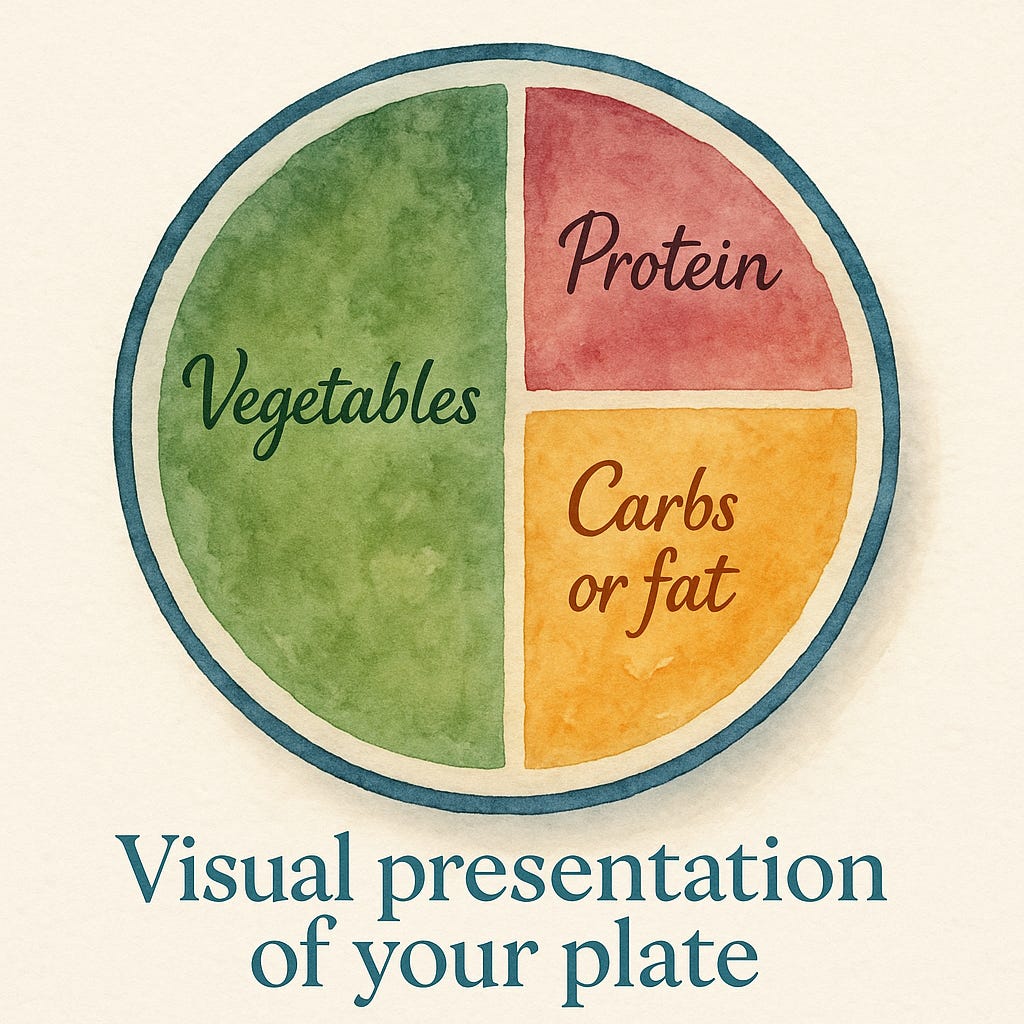
Start With Protein (Quarter of Your Plate)
The first and most important building block is protein.
Aim for a quarter of your plate or meal from protein. A good guideline is to aim for every meal to be around 30 grams of protein minimum (the higher, the better). These numbers are set for ease and guidance and are not set in stone. If you end up with 18 or 25 grams, it’s just an indication that you may need to balance and top up throughout the day.
However, the higher the protein, the higher your chances of feeling full and satisfied - it’s a good guideline to aim for. (One caveat: if you’re older than 60, some research suggests at least 30 grams of protein is needed to trigger maximal muscle protein synthesis.)
Look for high protein density foods. This could be chicken breast, turkey, shrimp, cod, Greek yoghurt, egg whites, cottage cheese, or tofu. If you opt for a lower protein density food like whole eggs, milk, peanut butter, or bacon, consider complementing it with another source of protein to bump up the total protein intake on your plate for fewer calories.
For example, mixing whole eggs with egg whites increases protein whilst keeping calories lower. (Just to be clear - eggs are nutritionally excellent, it’s just that to reach 30 grams of protein from whole eggs alone, you’d need about 5 eggs for around 350 calories, which doesn’t leave much room for other foods on your plate and can be a bit too much to consume in one go...)
Ideally, opt for a complementing protein source that also provides fibre, such as beans or lentils. Protein can be found in many foods, so everything you eat adds up, even if it’s not considered a protein food on its own. But as you structure your meal, make sure to start with a high protein density building block.
Feel free to combine different sources of protein - eggs and cheese, tuna and yoghurt, beans and tofu - all that protein adds up.
To read more about Protein, check this post:

Fill Half Your Plate With Low Calorie Density Vegetables
Next, fill half of your plate with low calorie density vegetables in a variety of colours.
These contribute a variety of micronutrients to your intake. They add bulk, volume, and nutrients with almost no calories. Many of them are high in water content. They’re filling, nutritious, and tasty.
This is also where we want to make sure we get a good intake of fibre. Some of the vegetables you put in your half-plate portion will be fibre-rich, such as cooked broccoli or Brussels sprouts, but there are better sources of fibre in terms of fibre quantity per portion.
Some of the best fibre sources are lentils, beans, chickpeas, chia seeds, flax seeds, and avocado. I usually aim to have half my plate full of a variety of vegetables, which have low calorie density and high nutrient value, especially when you make sure there is variety in sources and colours. Then I add a small “dedicated” portion for additional fibre - half a cup of beans, lentils, or a sprinkle of seeds. They all add up to the total fibre on the plate, but having that dedicated half cup makes sure I have my high fibre intake covered.
To read more about why Fibre is important for fat loss check this post:

The Last Quarter: Carbs, Fats, or Both
For the last quarter of your plate, you can choose to include any carbs, fats, or a combination of both, as you like.
With carbs, ideally aim for high fibre sources such as grains, oats, quinoa, sweet potatoes, or potatoes (especially with skin on, for added fibre) or high fibre, whole wheat bread.
With fats, aim for healthy fats such as avocado (also a good source of fibre), nuts and seeds or nut butters, and olive oil (as part of cooking whatever else you’re having). Oils are much more calorie-dense than other fat sources, so use them for cooking rather than as a dedicated portion on your plate.
The last quarter can be dedicated to carbs, dedicated to fats, or a mix of both. You can also choose to fill that quarter with more vegetables or proteins, because you’re likely to get carbs and fats from the rest of your plate either way.
Understanding How Foods Overlap
Now, this is a visual presentation of your plate: quarter protein, half vegetables, and a quarter with carbs or fat or a mix of both.
But the beauty of this method is that our foods don’t behave in such a siloed way. Many foods are a source of protein, fat, and fibre, just in different proportions - but as you eat them, they all add up.
If you’re having a fatty fish, which is a wonderful source of protein, you’re also getting great quality fat, as they’re rich in omega-3. So unless you’re keen on adding something else in your last quarter of a plate, you don’t necessarily need to add fats. If your vegetables are cooked in olive oil, or your eggs are fried with butter, you get fat from those other sources as well.
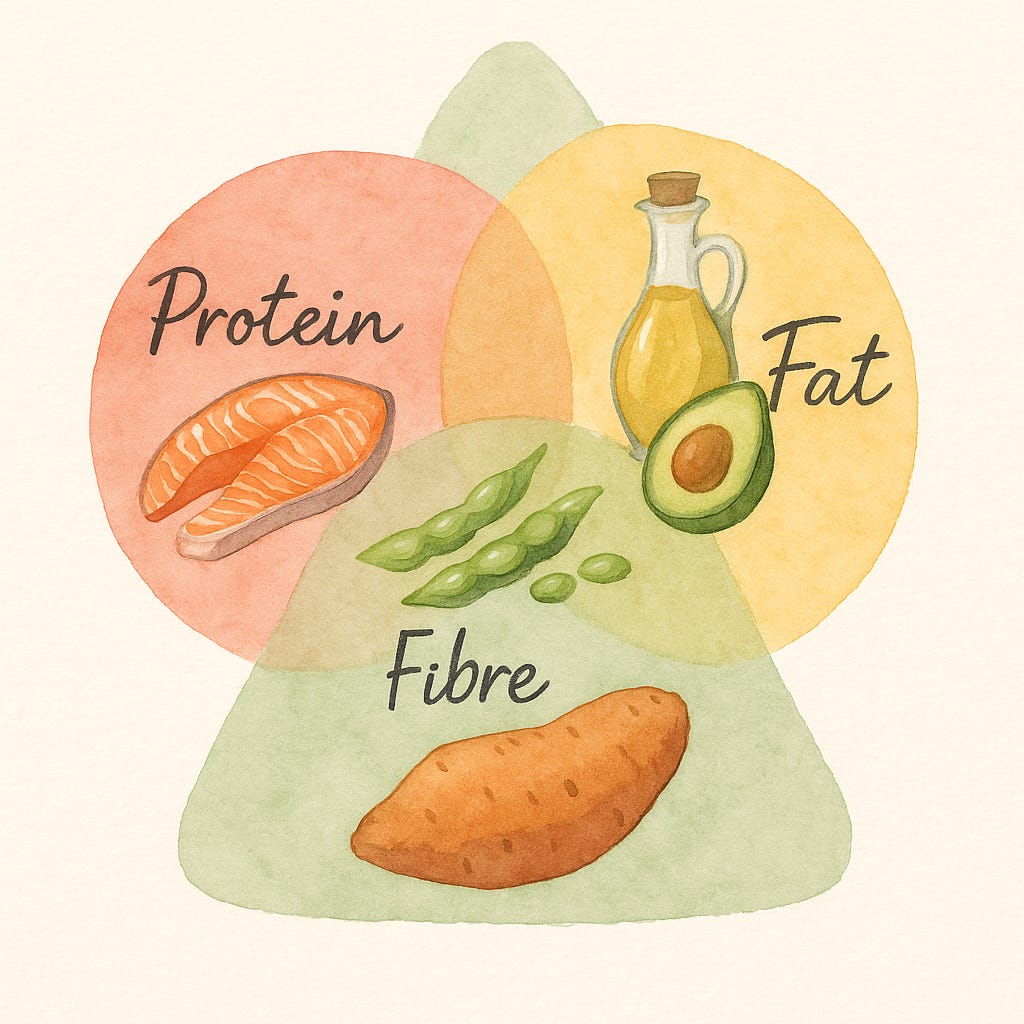
We “dedicate” part of the plate to specific macronutrients to make sure we prioritise what’s important. But if your carb is a sweet potato with the skin on, that’s a wonderful source of fibre.
Everything adds up. Protein from every piece of food on your plate. Fat from various sources of protein, and carbs in almost all plant foods. Fibre in avocado, which we usually think of as a fat source, or in soybeans (edamame), which is a great protein source.
Personally, I still look at my meals as allocated to different macronutrients. The first two - protein and fibre - are non-negotiables: quarter protein, half vegetables. But I sometimes skip the last quarter of fat and carbs if I feel they’ve been taken care of somewhere else, and there’s enough fat and carbs on the plate from other sources, or if I don’t crave them as much in a specific meal.
For some people, ingesting large amounts of fibre can create discomfort and gas, so start small and build up until you don’t feel any discomfort, or check if you might have a gut situation that needs optimising.
Quick Summary: The Easiest Way to Structure Your Plate
Start with protein - choose a dense source, fill a quarter of your plate. Bonus points if you can include fermented sources (such as some kefir mixed in with your Greek yoghurt).
Fill half the plate with a variety of vegetables (cabbage, carrots, broccoli, spinach, cucumber, tomatoes - whatever you love, a variety and a mix, and switch between meals). Bonus points if you include fermented sources, such as kimchi or sauerkraut.
Layer in a little bit of a good source of fibre - beans, lentils, and/or sprinkle some nuts or seeds to push fibre content up.
The last quarter can include carbs in any form (bonus points if they’re high in fibre such as oats, grains, or sweet potato), and or fat.
But the important thing is to choose things you love and enjoy. The guidelines are there to make sure you are satiated, satisfied, and healthy - but focus on choosing foods you enjoy and look forward to eating!
Making It Work in Real Life
What I found that worked for me is to have a couple of options that work really well, that I invested the thinking time in structuring to meet both enjoyment and the guidelines. Then I have them on repeat, varying some components every couple of days.
I still try to think about what I feel like having (sweet, salty, etc), but the choice is between a few limited options - three options and not much more. This helps with decision fatigue and with the temptation to suddenly find something completely different and maybe not as aligned with the way I want to eat (I save these for once in a while, not every other day). This makes healthy meals an automatic habit and of course you can always introduce new meals into the rotation.
Most days it’s the same 1-2 breakfasts, but I’m conscious of the importance of variety for nutrient intake, so my variations are within a theme. Same meal with different components.
Your plate doesn’t have to be split exactly by halves and quarters, but mentally think of these proportions as you’re choosing options. If you’re having soup for lunch, it should have the base with vegetables and proteins and a quarter or less from fat or carb sources (potato, sweet potato, croutons, etc.).
What About Portions and Calories?
Ideally, you won’t have to count calories and will be able to eat to satisfaction (not fullness, or feeling stuffed, or until you’ve cleared your plate). But that’s easier said than done, and it takes time to get there as well as for your body to adapt its ingrained habits.
The beauty of structuring your plates this way is that they’re optimised to meet your body’s needs as well as optimised for satiety - with volume, low calorie density, and high nutrient density - so it should be easier to feel satisfied.
Start with one plate, and if you’re still hungry after having it, make another one with the same exact principles. But only eat to satisfaction. As you practise this and your body gets adjusted to eating nurturing, filling meals, you should be able to learn to identify when you’re satisfied and stick to one plate.
If you’re just starting out and struggle to understand the right portions and how much to eat (which is very common), a good aim is somewhere between 400-600 calories per meal whilst you’re structuring them for the first time. Try to understand what fills you up (every day is not going to be the same - some days you’re hungrier, others you’re less).
This is not to get you tracking each bite or obsessing over calories, but as you start thinking about portion sizes, this is the area where you should be hitting with your three main meals. If you’re at the beginning of your weight loss journey or if losing weight is less of a priority, just eat to satisfaction.
The less you have to lose or the more important fat loss is as a priority at the stage you’re in on your journey, the more amounts, portions, and as a result, calories you consume will matter.
Nothing is Off-Limits
The beauty of thinking of your meals this way, focusing on whole foods, protein, fibre and variety of colour and sources is that nothing is off-limits. You’ll naturally have less space for the less healthy stuff if you focus on the guidelines when you eat your food. Less hunger means less need or urge to binge on empty sugars or processed carbs. The focus on whole foods means you should be satisfied before resorting to ultra-processed high fat, high sugar options. But there is still room in your life for those, once in a while and in small quantities.
Example Plates
Here are some real examples of what this looks like (and you can always have breakfast for dinner, or lunch for breakfast - I often do!):
Breakfast Options:
Oats with egg whites, cacao, cherries, soy milk and chia seeds
Greek yoghurt (mixed with some fermented kefir) with seeds and nuts, raspberries/blueberries (or a hot jam made from frozen berries cooked with chia seeds), and nut butter
Eggs with spinach, cheese, and white beans, in tomato sauce
Tofu, black beans, fried onions, spinach, Mexican spices
Tuna with Greek style yoghurt, everything but the bagel seasoning, kimchi, tomatoes, and scallions
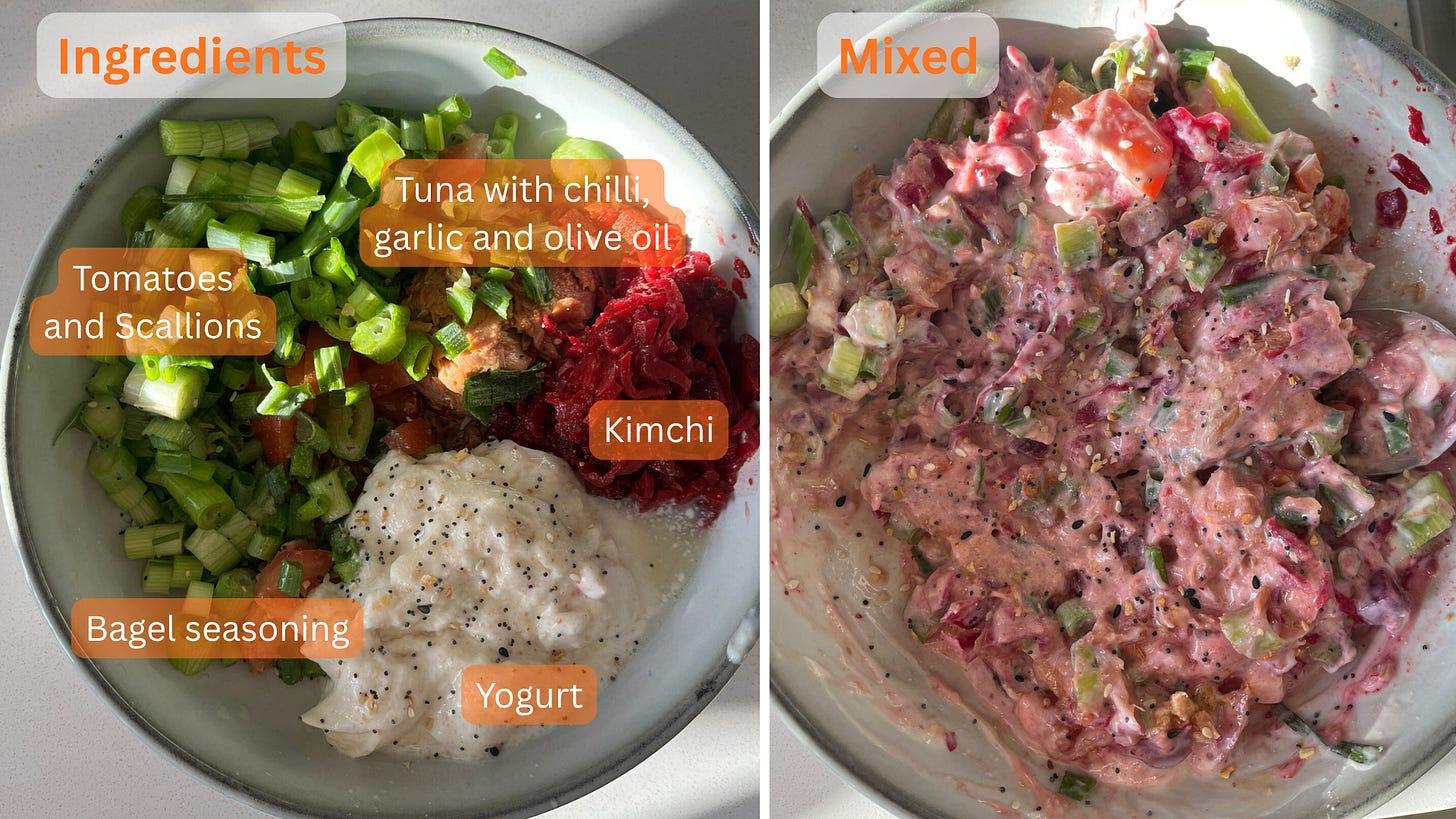
A beloved breakfast: tuna, vegetables, purple cabbage kichi, yogurt and everything but the bagel seasoning - mixed together to some sort of tuna salad.

Lunch Options:
Quinoa with lentils and a variety of vegetables
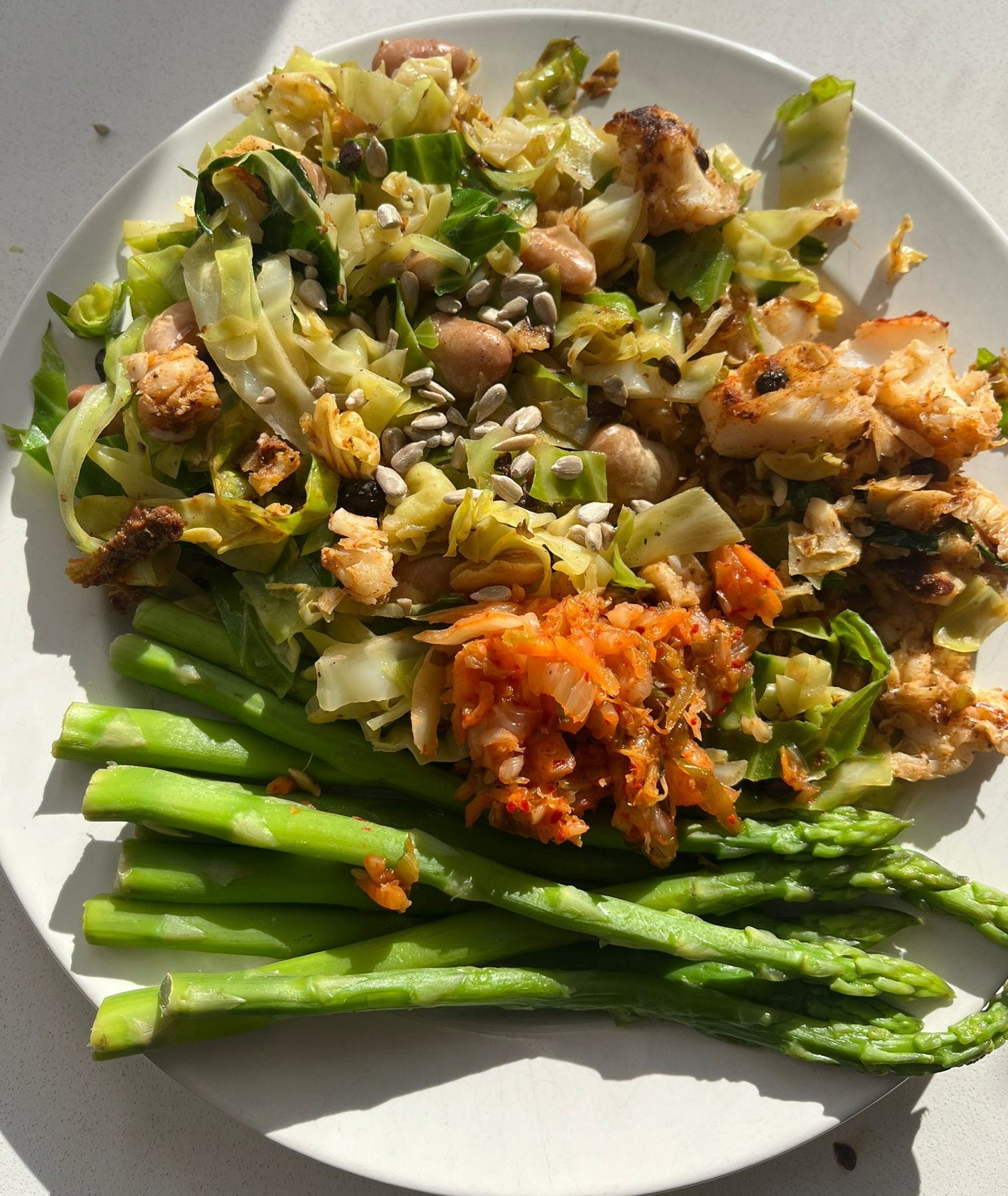
Cod loin, steam-fried sweetheart cabbage with lentils or beans, asparagus and kimchi
Chicken breast, sweet potato, leeks, courgettes, onions
Dinner Options:
Grilled chicken, lamb or fish with roasted vegetables and a small portion of sweet potato
Tofu stir-fry with mixed vegetables and brown rice
Bolognese made with low-fat beef mince, lentils, vegetables and pasta (try soy/lentil based pasta for added protein or mix spiralised courgettes or some other vegetable as part of your regular pasta base)
Bean dish, with tomato sauce base and lots of vegetables and some sourdough whole grain bread or rice
Remember, we think of foods as belonging to one category - protein, carb, fat - but in reality, it’s the percentage or density of a specific macro that matters. Almost everything has some of everything. It all adds up.
Let’s dig in!
You don’t need someone else’s meal plan. You need to understand how to build your own plates in a way that serves your body, your goals, and your life.
Quarter protein. Half vegetables (of low calorie density fruits). A quarter for carbs, fats, or both. Prioritise whole foods, include variety, and add fermented foods when you can. You’ll be satisfied, full, and will naturally have less room or urge to eat less healthy foods. But if you want to? Go ahead. It’s all part of the joy of food and life.
That’s your framework. Not a rigid rule, but a flexible guide you can use anywhere, anytime, for the rest of your life.
Could you make it work for you?