

Let me ask you something: when was the last time you thought about your water intake as part of your weight loss strategy?
If you’re like most women, you know you “should” drink more water. You’ve heard it’s good for you. Maybe you even carry a water bottle around. But if I asked you how much you actually drank today, you’d probably have to guess.
Here’s the thing: water isn’t just “healthy.” It’s one of the most underutilised tools for weight loss, and I’m not talking about some trendy lemon water detox or alkaline water invention.
I’m talking about plain, simple water. Enough of it. Consistently.
7 Ways Water Supports Weight Loss and Helps You Feel Your Best
1. Water Fills You Up - Literally
When you drink water, it takes up physical space in your stomach. This triggers stretch receptors in your stomach wall that send “I’m full” signals to your brain.
Research shows that humans tend to consume roughly the same weight of food each day, regardless of how many calories that food contains. We eat until we feel physically full, until our stomach is satisfied, not until we’ve hit a specific calorie target.
This means that when you drink water with or before meals, you’re adding weight and volume to what’s in your stomach without adding calories. You’ll reach that “satisfied” feeling earlier and naturally eat less food.
In one study, people who drank two glasses of water right before a meal ate about 22% fewer calories than those who didn’t drink water beforehand. Another study specifically involving middle-aged and older adults found that drinking about 500ml (roughly 2 cups) of water before each main meal led to about 2 kilograms (around 4.4 pounds) more weight loss over 12 weeks compared to a group who dieted without the extra water.
That’s a significant difference from such a simple habit.
It’s important to say: the idea is not to drink water instead of eating proper meals. You are not trying to get full on water so you don’t need to eat. It’s to make sure that once you’ve eaten enough nourishing food, you’re not continuing to eat needlessly in response to other needs that aren’t actually hunger.
2. Your Brain Confuses Thirst and Hunger
This is one of the most important things you need to understand about hydration and weight loss.
The sensations of thirst and hunger originate from neighbouring areas in the brain - specifically, the hypothalamus. These areas are so close together that your brain sometimes confuses the signals. What feels like hunger might actually be thirst.
Think about how many times you’ve felt “hungry” between meals, reached for a snack, and then still felt unsatisfied afterward. There’s a good chance your body was asking for water, not food.
This confusion becomes even more problematic as we age. Our natural sense of thirst becomes less acute in midlife. By the time you feel genuinely thirsty, you might already be mildly dehydrated. And by then, your brain has probably been sending you false hunger signals for a while.
Instead, when you feel hungry after eating a proper meal, drink half a bottle of water - not just a glass. Really get full on water. Wait 10-15 minutes. More often than not, you’ll notice that craving has gone. If you were actually just thirsty, that hunger sensation will disappear. If you’re truly hungry, you’ll still want food - but you’ll have satisfied your hydration needs first.
Again, this is not about replacing nourishing food with water. This is about making sure you’re eating to fulfil your need for food and not for other reasons. You are not trying to trick your mind into having water instead of food, but help distinguish between two different needs.
3. Dehydration Makes Everything Harder
It’s easy to not drink enough, and when you don’t, it cascades into so many other things that impact how you’re feeling.
Even very mild dehydration - the kind where you don’t even feel particularly thirsty - can make you feel tired, sluggish, and unable to concentrate. Your energy drops. Your motivation plummets. You feel less inclined to move your body, exercise, or do the things that move you in the direction you want to go.
It’s important to recognise that your body needs adequate hydration to function optimally. Every single cell in your body depends on water to work properly. When you’re running on low, everything becomes harder.
Staying properly hydrated sets the stage for feeling your best. It gives you the energy and mental clarity to follow through on your positive habits. It’s one piece of the foundation - not the whole building, but an essential part of it.
4. The Water Retention Paradox
The more water you drink, the less likely you are to retain water and feel puffy, bloated and heavy.
It sounds counterintuitive, but here’s how it works.
When you’re dehydrated, your body releases a hormone called antidiuretic hormone (ADH), also known as vasopressin. This hormone signals your kidneys to hold onto water and produce less urine - your body’s way of conserving the water it has. When you drink enough water regularly, ADH secretion is suppressed. Your kidneys release water normally, and you don’t retain excess fluid.
In other words: drinking too little water triggers your body to hold onto every drop it can get. Drinking enough water signals your body that there’s plenty available, so it doesn’t need to hoard it.
Now water retention isn’t the same as fat gain, but feeling puffy and bloated is uncomfortable, might make you feel self conscience and can mask your progress on the scale. The best way to reduce puffiness and reverse water retention is actually to drink more water, not less.
5. Water Helps Keep Your Stress Hormones in Check
Chronic low fluid intake has been shown to increase cortisol responsiveness. Cortisol is your primary stress hormone, and while it’s essential for life, chronically elevated cortisol is problematic for both weight loss and health.
Research shows that people who habitually drink less than about 1.5 litres daily have exaggerated cortisol responses when faced with stressful situations. Their bodies release significantly more cortisol in response to stress compared to people who stay well-hydrated.
Elevated cortisol makes fat loss harder, particularly around your middle. It also affects your appetite, energy levels, and sleep quality. While drinking water won’t eliminate whatever stress life might bring, staying hydrated helps ensure your body’s stress response doesn’t become amplified by dehydration.
Making sure you are drinking enough is one way to support better hormone balance, which in turn supports your fat loss efforts.
6. Fibre Needs Water to Work
If you’re eating more fibre to support your nutrition and health (and you should be - fibre is fantastic for satiety, blood sugar management, and gut health), you absolutely need to drink more water.
Both types of dietary fibre - soluble and insoluble - rely on water to function properly.
Soluble fibre dissolves in water and forms a gel-like substance in your digestive tract. This gel helps you feel fuller for longer and supports healthy blood sugar levels. But without adequate water, soluble fibre can’t form that gel.
Insoluble fibre doesn’t dissolve in water, but it attracts water into your stool, making it softer and bulkier. This helps move things through your digestive system smoothly and prevents constipation. Without enough water, insoluble fibre can actually worsen constipation rather than relieve it.
If you’ve increased your fibre intake and feel bloated or constipated, the solution isn’t usually to reduce fibre - it’s to increase your water intake. The two work together.
As a general rule: as your fibre intake goes up, your water intake needs to go up proportionally.
7. Water Supports Regularity and Waste Elimination
Water helps your digestive system move food through your gastrointestinal tract, prevents constipation, and supports the elimination of waste products from your body.
When you’re constipated or irregular, you feel bloated, uncomfortable, and sluggish. You’re also literally carrying around extra waste weight. More importantly, feeling physically uncomfortable makes it harder to stay active and make good choices.
Your body also eliminates metabolic waste products through urine. When you’re well-hydrated, your kidneys can efficiently filter your blood and remove waste. When you’re dehydrated, this process becomes less efficient. So drinking enough also supports your liver’s detoxification processes.
Being regular isn’t just about comfort - it’s about your body being able to efficiently eliminate what it doesn’t need. Water is essential for this process.
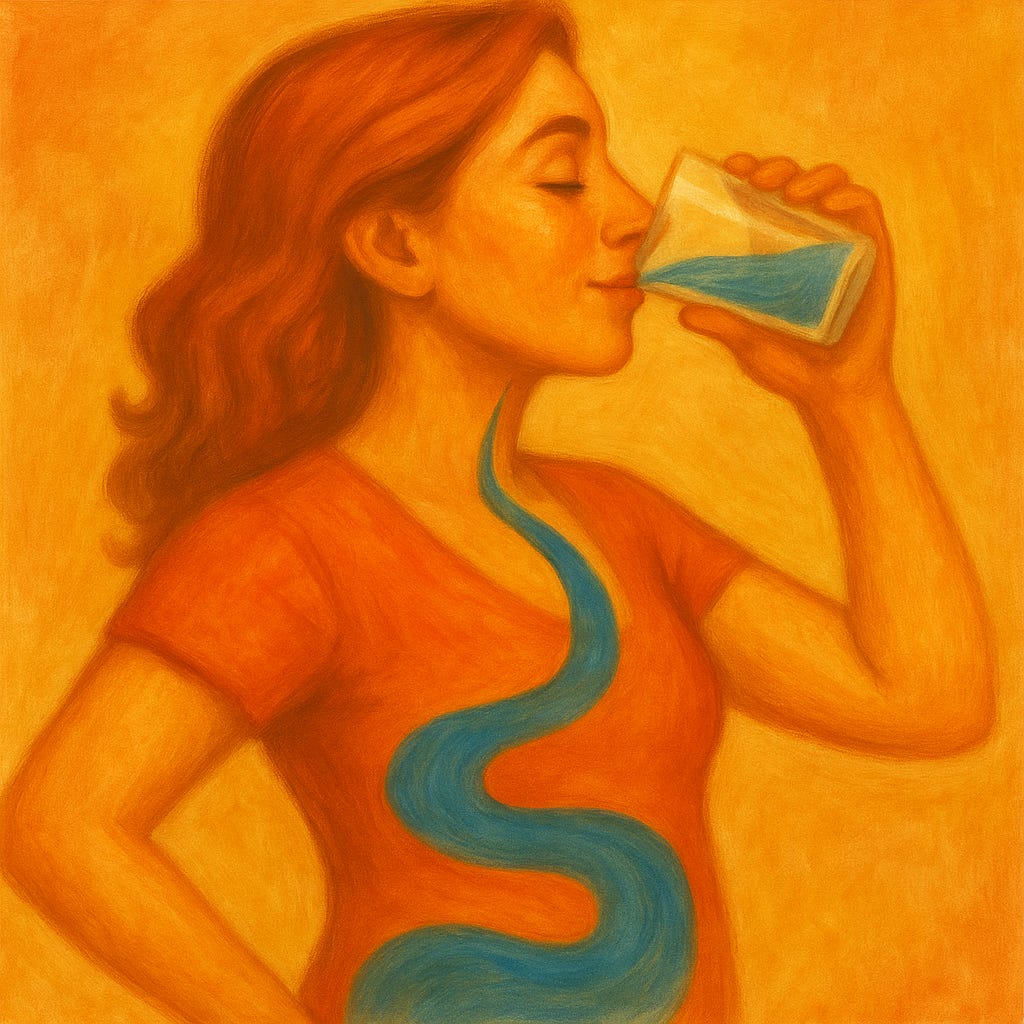
Why “Just a Glass Here or There” Isn’t Enough
Here’s where a lot of women go wrong: they think having a glass of water with lunch and maybe one at dinner is sufficient. But you’re missing out on most of the benefits we’ve just discussed.
Chronic mild dehydration is incredibly common. You might not feel desperately thirsty, but your body is operating below optimal capacity. Your metabolism is slightly suppressed. Your energy is lower. Your brain is foggier. You’re more likely to mistake thirst for hunger and keep looking for something to eat. You’re not getting the satiety benefits of water filling your stomach. Your fibre isn’t working properly. Your cortisol response to stress is amplified.
Think of hydration like sleep or nutrition - you can’t just do a little bit and expect full benefits. You need consistency and adequacy.
The goal isn’t to occasionally drink water. The goal is to drink enough water throughout the day, every day, so that your body is consistently well-hydrated and water intake becomes automatic.
This means having water available and drinking it regularly - not just when you remember or when you’re parched, but throughout the day as a habit.
How Much Water Should You Actually Drink?
You’ve probably heard the classic advice: “Drink eight glasses of water a day.”
This 8x8 rule (eight 8-ounce glasses, which is about 2 litres or roughly 68 fluid ounces) is a decent simple target for many people. In reality, the ideal amount varies from person to person.
General guidelines suggest about 2-2.7 litres (roughly 68-91 fluid ounces, or 8-11 cups) of total fluids per day for women. This includes all beverages (including tea and soups) and even foods containing water, such as watermelon. About 20% of our water typically comes from foods, and the rest from drinks.
So if you aim for roughly 8-12 cups of water a day, you’re in the right ballpark for most adults. Personally I find it easier to have a bottle of water around whose quantity i know and just make sure i refill it twice. That way i can drink whenever i feel like it and am not limited to finishing a glass or stopping when one finishes, as long as I know i refiled and finished it twice (obviously depends on the size of your bottle and the volume you are trying to consume).
One practical way to check that you’re drinking enough: look at the colour of your urine. A pale, light yellow colour (similar to the colour of pale camomile tea) generally means you’re well-hydrated. Dark yellow urine verging on orange is a sign you need to drink more.
What’s important to know, is that thirst isn’t always a reliable indicator. You might not feel particularly thirsty even when you’re under-hydrated. Your body’s signals can lag behind its actual needs, especially as you get older.
The Myth: Does Drinking Water With Meals Harm Digestion?
You might have heard that drinking water with meals “dilutes your stomach acid” and impairs digestion or nutrient absorption. But there is no research to indicate that’s the case.
According to gastroenterologists, water does not dilute stomach acid or enzymes in any meaningful way. The human digestive system actively adjusts its secretions - acid, bile, enzymes - based on the consistency and contents of a meal.
Even if you drank 300ml (about 10 fluid ounces) of water with a meal, your stomach compensates almost immediately by producing more acid. Studies show gastric pH returns to its normal acidic state within minutes.
Clinical studies and reviews found no evidence that drinking water or other fluids with meals impairs digestion or nutrient absorption. Research specifically measured stomach emptying and found that adding water had no effect on the digestion rate of solid food.
In fact, water is a natural part of digestion. Our saliva is mostly water. Stomach acid itself contains water. Water helps break down solid food into chyme (the semi-liquid mixture that moves into our small intestine), which actually aids nutrient absorption rather than hindering it.
On the other hand, there are many benefits to drinking water with meals:
Water helps soften and move food along the gastrointestinal tract, which can prevent constipation and bloating
It encourages slower eating - pausing to sip water can help you tune into fullness signals and prevent overeating
It contributes to your daily fluid needs without adding calories
Drinking water before or during meals increases satiety and can help you naturally eat less, which supports weight loss
So drink water with your meals if you want to. In fact, doing so can help you feel fuller, eat less, stay hydrated, and support smooth digestion.
Practical Tips to Help You Drink Enough
Carry a water bottle everywhere - Keeping water accessible makes you more likely to sip regularly. You can even mark the bottle with time goals (halfway by noon, for example) to pace yourself. Personally, I find that drinking from a bigger bottle means I drink more each time than if I just grab one glass at a time.
Start your day with water - Drink water first thing in the morning. It rehydrates you after sleep and helps you stay on track with hydration throughout the day.
Drink before meals - Make it a habit to drink a full glass before each meal. Drink while you’re making the meal, as part of putting things together (even if it’s just as you’re grabbing them out of the fridge). This helps with satiety and ensures you’re not mistaking thirst for hunger.
Drink before you snack - If you feel like having something to eat between meals and you know you recently ate enough, it’s usually a good habit to drink half a bottle of water and wait 15 minutes to see if the urge goes away. If you’re eating well and enough in your main meals, you might find that it was just your body signalling it needs more water.
Add flavour - If plain water is boring, you can add lemon, lime, cucumber, orange slices, or herbs like mint. Unsweetened herbal teas count towards your hydration too, and you can steep a herbal tea, let it cool down, and drink it as ‘flavoured water’.
Set reminders - Some people find it helpful to set an alarm or use a smartphone app. Even a sticky note on your desk saying “Drink Water” can help. Over time, it should become automatic.
Replace sugary drinks - Choose water over fizzy drinks, sweet tea, or juice. You’ll cut a lot of empty calories. Swapping a can of fizzy drink for water saves you about 150 calories or more. I find that It’s a better mindset to think of any flavoured, sugary drink (even diet ones) as a sort of snack or food. Despite being in liquid form, think of it as a treat with your meal or without, not as an alternative drink to water. Water is water and can come as still or sparkling, but don’t think of it as another drink - it should be in a category of its own.
Be mindful of alcohol and caffeine - Both have a diuretic effect, which means they make you lose water and increase urination. You don’t have to eliminate them, but be conscious to drink extra water when you consume them. This is really easy to mitigate - for every cup of coffee or glass of wine, have an extra glass of water.
Adjust for activity - If you exercise, drink before, during, and after your workouts. Don’t wait until you’re done.

Water is one of your best allies on your weight loss journey.
It helps control hunger by preventing the confusion between thirst and hunger signals. It increases feelings of fullness, which naturally helps you eat less. It keeps your stress hormones from becoming amplified. It helps your fibre work properly. It supports regularity and waste elimination. And it sets the stage for you to feel energised and capable of following through on your other healthy habits.
Even more importantly, water keeps your body functioning optimally - from cognitive function to digestion to hormone regulation.
It’s one of the simplest things you can do for your health and weight loss, and one of the most powerful.
Immediately went and had some water🙏