

You cannot live in today’s world, be even mildly interested in health, weight, or our complicated relationship with food, and not have an opinion on weight loss medications, also known as GLP-1s.
They are everywhere: in the news, in conversations, on social media or being taken by people you know. Let’s face it, someone in your life is either already on one, thinking about it, or has an opinion about someone who is.
As a soon to be nutritional therapist and someone who is planning to be active in this field you can’t talk about food, health and weight without understanding the systemic shift that is glp-1 medications.
So I went deep on this topic - reading the research, following the clinical trials, going through hundreds of Reddit testimonials from people on a medicated weight loss journey, and talking to people who are on these medications.
In the coming posts, I will be sharing a series of articles on GLP-1 medications - what I am learning and my thoughts about them.
I am not suggesting you should take them, and I am not suggesting you avoid them. I don’t think that’s my place, and frankly I don’t think it’s anyone’s place but yours and your doctor’s. What I do believe in, and what sits at the core of everything I write about, is that understanding the science behind what’s happening in your body puts you in a fundamentally better position to make decisions that are right for you. These medications are here, they are not going anywhere, and the conversation around them deserves more nuance than it usually gets.
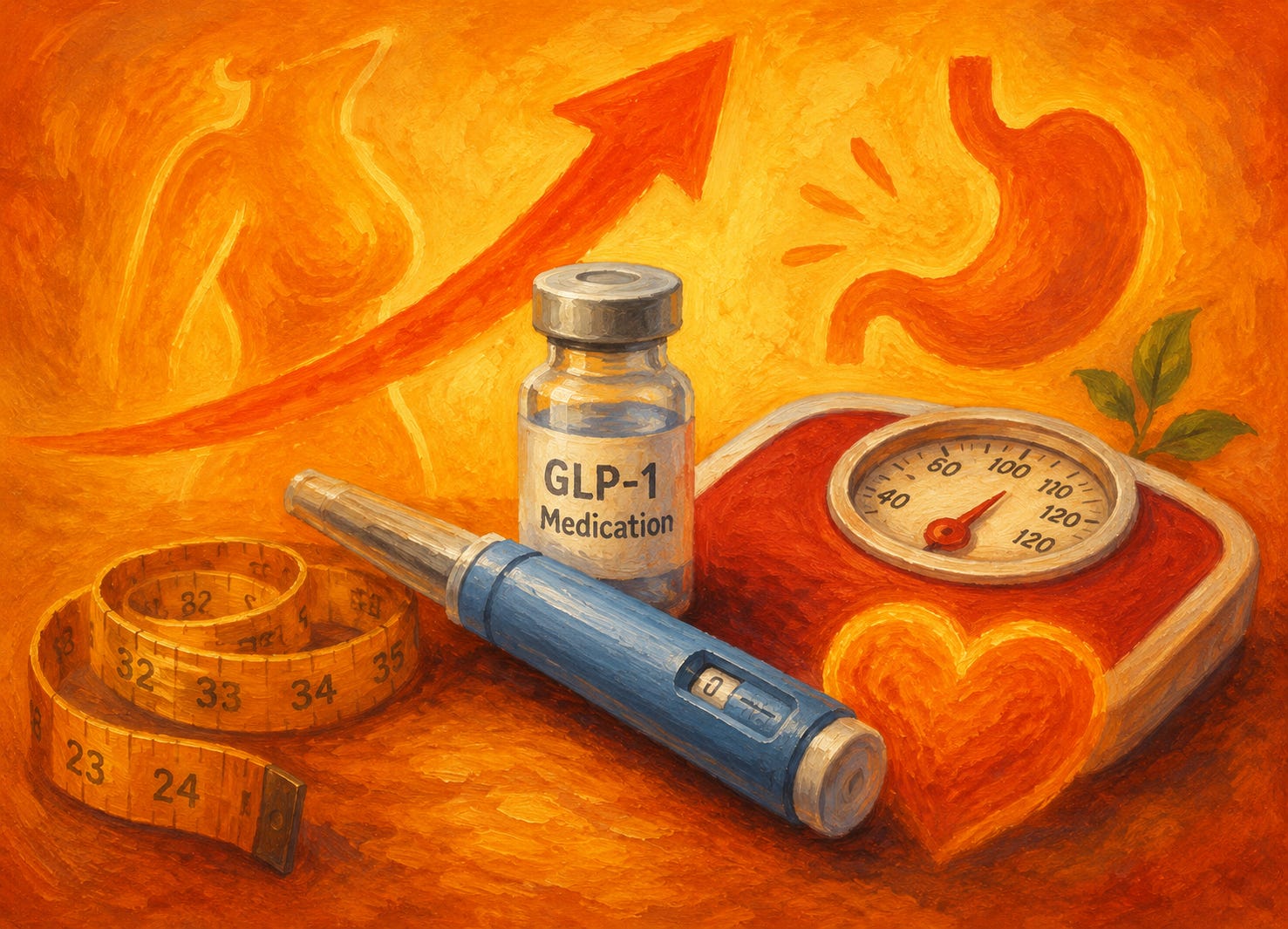
One thing we can all agree on: It’s a revolution and it’s happening at scale
In the US, an October 2025 Gallup poll found that 12.4% of Americans (more than 30 million people) were taking a GLP-1 medication specifically for weight loss. That’s one in eight American adults. Nearly one in five American adults say they have taken a GLP-1 drug at some point in their lives.
In the UK, an estimated 1.6 million adults used drugs like Wegovy and Mounjaro for weight loss between early 2024 and early 2025, with an additional 3.3 million saying they would be interested in doing so in the coming year.
A study published in The Lancet, pooling data from 810,635 adults across 99 countries, found that more than one in four adults worldwide would be eligible for GLP-1 medications for weight management. That’s not a niche trend, it’s a global shift in how we think about and treat weight.
In Europe, Novo Nordisk - the Danish pharmaceutical company that makes Ozempic and Wegovy - became so profitable that its market cap at one point exceeded the entire GDP of Denmark. The entire country’s economic output, as a result of the success of products by one single company and one single drug class.
Weight loss medications are not just the latest health trend. They are a seismic shift.
How did we get here?
To understand why these medications are generating this level of attention, it helps to understand the scale of what they’re addressing. Around 70% of American adults are classified as overweight or living with obesity. In England, 64% of adults are classified as overweight or living with obesity, with 26.5% meeting the clinical definition of obese. These numbers represent a significant burden on individual health, quality of life, and healthcare systems.
This obviously goes way beyond aesthetics, it increases risk for type 2 diabetes, cardiovascular disease, certain cancers, joint problems, sleep apnea, and more. Researchers, doctors, and public health officials have been trying to address this for decades - through public campaigns, nutritional guidance, fitness programmes, endless diet plans - with very limited success at a population level.
And then something changed. In 2017, almost a decade ago , Ozempic was approved as a diabetes medication. Type 2 diabetes is essentially a blood sugar management problem - the body either doesn’t produce enough insulin, or doesn’t respond to it effectively, so glucose from food builds up in the bloodstream instead of being used for energy.
GLP-1 medications address this in two ways: they prompt the pancreas to release more insulin when blood sugar rises after eating, and they suppress glucagon - the hormone that signals the liver to dump additional sugar into the bloodstream. The result is better blood sugar control, without the risk of dangerous drops in blood sugar that older diabetes medications carried, because both effects only kick in when glucose is actually elevated, i.e. when food is eaten.
As those medications were prescribed, patients and doctors began noticing something unexpected: significant, sustained weight loss. That side effect turned out to be so consistent and so substantial that it eventually became the main story. By 2021, a higher-dose version had been approved specifically for weight management under the name Wegovy and you know the rest of the story. A diabetes drug accidentally became the most effective weight loss medication ever developed.
How do they work?
GLP-1 stands for glucagon-like peptide-1, a hormone your small intestine naturally produces when you eat. This hormone does several things: it triggers insulin release and as a result lowers blood sugar levels, it slows the rate at which food empties from your stomach, and most importantly, it signals to your brain that you’re full and satisfied. It’s a natural part of our satiety system that’s there to say: food came in, we had enough and we can stop eating, cue satiety.
GLP-1 receptor agonists are drugs that mimic and amplify this hormone’s effects. In pharmacology, a receptor agonist is a molecule that binds to a receptor and activates it. It mimics the action of the natural substance that would normally bind there. So a GLP-1 receptor agonist is a drug that binds to the same receptors that your naturally produced GLP-1 hormone would bind to and triggers the same biological response. It’s essentially doing an impression of your own hormone, just a much longer-lasting and more potent one.
Natural GLP-1 hormone has a half-life of around 2 minutes in the bloodstream before it breaks down (half life = how long it takes for the concentration of a drug in your body to reduce by half and hence a proxy for how long it is still active in the body). These drugs have a half-life of between 5-7 days and they act consistently in the body, 24/7.
Let’s talk drug names
The two compounds you’ll hear most about are:
Semaglutide - sold as Ozempic (the diabetes version) and Wegovy (exact same medication, approved specifically for weight loss). Made by Novo Nordisk and available as a once-weekly injection that works on the GLP-1 receptor. As of June 2026, the Wegovy pill has also been approved by the MHRA here in the UK. The first oral GLP-1 medication licensed specifically for weight loss, taken once daily. A significant development hoping to entice people that were put off by the need to inject themselves.
Tirzepatide - sold as Mounjaro (diabetes) and Zepbound (weight loss) - again, the exact same drug with different designations. Made by Eli Lilly and available as a once-weekly injection that works on two receptors simultaneously - GLP-1 and another hormone called GIP (glucose-dependent insulinotropic polypeptide). GIP is a gut hormone that works alongside GLP-1 to regulate insulin after meals and plays a role in how the body processes and stores energy from food. Because tirzepatide targets two pathways rather than one, it tends to produce greater weight loss. Clinical trials showed average weight loss of around 20% of body weight on the highest dose - something never seen from a weight loss medication before.
The drug in the pen is identical whether it’s prescribed for diabetes or weight loss. Only the licensed indication and the dose differ.
The next generation is already in development
This field is moving fast and it’s probably safe to say that most pharma companies are looking into some version of weight medication. Retatrutide is the most talked-about drug currently in late-stage clinical trials. It’s a triple agonist - meaning it targets three hormone pathways simultaneously: GLP-1, GIP, and glucagon. The glucagon activation is designed to increase how many calories the body burns at rest, adding an energy expenditure component on top of appetite suppression. In other words, you are not only limiting the number of calories coming in, but also increasing the number of calories going out - a combination that produces significant weight loss results.
Early trial data for retatrutide suggests weight loss potentially exceeding 20%, with reports of some participants having to quit the trials because they lost weight too quickly. There is no full regulatory approval data yet, but the direction of travel is clear: each new generation of these drugs appears to be more effective and better tolerated than the last.
How they actually work in the body
GLP-1 is not just a gut hormone. GLP-1 receptors are distributed across multiple locations in the body: in the pancreas, where they trigger insulin release; in the stomach, where they slow digestion so you stay full longer and very importantly: in the brain - specifically in the hypothalamus, the region that regulates hunger and fullness, and in the brainstem areas involved in reward and motivation.
When you eat, your intestine releases GLP-1 into the bloodstream. It travels to these receptor sites and triggers a cascade of responses: insulin goes up, digestion slows, fullness signals switch on. It’s a coordinated system that’s working anyway, for everyone, but with the medication they work for longer.
What these medications do is not trick the body. They amplify and extend a real, existing signal - the same one your body naturally produces after eating. The difference is duration: natural GLP-1 breaks down in minutes. The medication version lasts days, keeping satiety and blood sugar signals active at a consistent level.
Now this is the most fascinating part: research suggests that people with obesity produce up to 20% less GLP-1 in response to eating than people of a healthy weight. People with prediabetes produce up to 25% less GLP-1.
What makes this even more interesting is that this reduction appears to come before obesity develops, not just as a result of it.
In other words, a blunted or reduced satiety signal may be part of what made weight gain harder to resist in the first place - not a consequence of it. There is also evidence this is partly genetic: GLP-1 responses appear to be heritable, i.e. some people are simply born with a weaker satiety signalling system.
The point I want to make is that for many people, this isn’t about overriding biology. It’s about compensating for a deficit that was likely there all along - one that made hunger louder and fullness harder to feel, not because of a lack of willpower, or eating the wrong foods, but because of how their physiology was wired to start with.
GLP-1 and the brain
Another fascinating part of the biology is that GLP-1 receptors exist not just in the hunger regulation centres of the brain, but also in areas involved in dopamine signalling: the same system that drives craving, pleasure-seeking, and motivation.
When these receptors are activated, something shifts in how the brain processes reward. Things that felt compelling before: food, alcohol, nicotine - become less interesting and people report feeling less of a pull to consume them.
A 2025 randomised clinical trial published in JAMA Psychiatry found that people with alcohol use disorder who took low-dose semaglutide for nine weeks reported significantly fewer cravings and drank less on days they did drink compared to the placebo group. Another 2024 study in Nature Communications found that people prescribed semaglutide had a 50-56% lower risk of developing or relapsing into alcohol use disorder compared to those taking other weight loss medications. Early trials have also shown reductions in nicotine cravings and cigarettes smoked per day.
What this tells us about the mechanism is that these medications aren’t simply making people less hungry. They appear to dampen the brain’s reward response to things it had previously found irresistible. For people who have spent years feeling pulled towards food, alcohol, or other compulsive behaviours despite actively trying to stop, that is quite a finding. It also suggests these struggles were always more about brain chemistry than character.
Food noise
I have read a ton of posts by patients on the medications. When they talk about their experience, one idea keeps coming up again and again, in slightly different versions and phrasing: “So is this how people who don’t struggle with food feel all the time?”, “I never believed thin people when they said they could forget to eat - now i get it” and so on. I don’t know if people who are thinner find themselves less preoccupied with thoughts about food but the concept is fascinating.
Food noise, the mental chatter about food: what to eat, what not to eat, resisting cravings, thinking about the next meal, negotiating with yourself constantly, all seem to just go away on these medications.
Many people, used to living like this for years, didn’t even realise it was a thing before they started on the medications. It was just the background hum of existing, who they were. It’s only when it disappears that people realise how much of a presence it had in their life.
Researchers are still trying to figure out exactly why this happens. Part of it is the slower gastric emptying (food stays in the stomach longer, so fullness signals stay for longer). Part of it is direct action on the brain’s reward pathways. But the experience itself, the silence after years of noise, is one of the most striking things people report, and it tells us something important about what was actually happening in the brain of people who struggle with food and weight. It was never just a lack of willpower…
I will probably write a separate post on this, but i find it very striking that the introduction of these medications and what we are learning about weight and biology as a result of it, might have strong implications culturally, in how our culture perceives people who are overweight or obese and about the ‘moral’ attributions historically made about what being fat signals. It makes you stop and think.
This is only the beginning…
GLP-1s are turning out to be an economic and cultural phenomenon, not just a medical one. The food and beverage industry is already modelling scenarios in which widespread GLP-1 adoption leads to a significant reduction in calorie consumption and grocery spending (less appetite means you don’t buy as much food). Airlines have reportedly been factoring in potential reductions in average passenger weight when calculating fuel needs. Fast food chains are preparing for reduced demand.
These sound like speculations. But the fact that these industries are modelling these scenarios tells you something about how bigger the scale of this shift could develop.
This is the beginning of the conversation, not the end
What’s clear is that GLP-1 medications represent something genuinely new - a class of drugs that work through biological mechanisms science has never been able to target effectively before.
And yet there is a big missed point in the conversation.
A medication that reduces appetite doesn’t automatically teach you how to eat well. It doesn’t build the habits that sustain health beyond weight loss. It doesn’t address the relationship with food that developed over decades. It doesn’t maintain muscle mass, support bone density, or ensure you’re getting adequate nutrition - things that are hugely important for health during weight loss and are much harder to address when hunger signals are muted and you need to make every calorie you eat, count.
The medication changes the conditions, it makes the journey significantly easier for many people, as hunger is no longer an issue to deal with - but it doesn’t do the work itself.
The research reflects this. When people stop taking the medications, a significant proportion regain a lot of the weight they lost. One major trial found participants regained two thirds of their lost weight within a year of stopping. That isn’t a reason to dismiss these medications, but it is a reason to think carefully about what else needs to happen alongside them.
When reading testimonials and accounts from actual patients - many of them are able to ‘graduate’ GLP-1 and maintain the loss. What makes them different is usually the way they went about the weight loss process - what they did beyond taking the medication and how they continued to follow those habits, afterwards.
The biological fundamentals - how you eat, how you move, how you sleep, how you manage stress - don’t become less important just because your appetite is suppressed. If anything, that’s precisely the time to work on them.
Whether you are considering this path, already on it, or committed to finding your happy weight without medications, understanding how your body works and how to support it remains the foundation.
As part of this series and over the coming posts I hope to cover how these medications actually work in more depth, the side effects that often get sensationalised in the media and what the research actually shows about managing them, how to eat and nourish your body properly while on them, and the bigger questions around long term use and what happens when you stop. There is a lot to cover and a lot of nuance that gets lost in the noise.
I would love to hear your thoughts and experiences in the comments and If there are specific questions or topics you’d like me to address in the future - things you’re wondering about, confused by, or that you haven’t seen covered well elsewhere - let me know. I’ll do my best to get to them.
Very interesting. I am very much looking forward to reading more. Very interested to see if it is worthwhile to continue to fight weight and food noise without any medications or if it may be worthwhile looking into these “new” meds. Very interested to see what exactly are the downsides of medication (other than financial). The immediate side effects and also the long term effects. Thank you!!!