

There’s one nutrient that acts like a natural Ozempic in your body.
It triggers the same appetite-suppressing hormones. It helps your body burn fat instead of storing it. And it’s sitting in your kitchen right now.
No, it’s not a supplement. It’s not expensive. And you’ve probably been told to eat more of it your whole life - but nobody explained why it actually matters.
Fiber. Most of us think of fiber as the boring nutrient that keeps us regular. Something we should have more of, like flossing or drinking water. Good for us, sure, but not exactly exciting.
But what if I told you it’s one of the key pieces to help you conquer weight loss, once and for all? That it’s one of the biggest levers - right alongside protein - you can use to control your appetite? That it influences how your body processes and stores the calories you eat? That it’s quietly working behind the scenes to regulate your hunger, influence your hormones, and literally change how your body decides whether to store fat or burn it?
Boring fiber suddenly doesn’t sound so boring anymore.
Stay with me, because by the end of this article, I’ll show you why fiber is one of the key things you need to pay attention to in your nutrition journey.
Increasing your fiber intake from whole foods can help control your hunger, make your weight loss journey easier, and support your health at the same time. For women over 40, especially those of us navigating perimenopause and beyond, understanding fiber isn’t just about better digestion. It’s about unlocking a key ingredient in your weight loss journey and your health.
What Fiber Actually Is (And Where to Find It)
Before we dive into what fiber does for you, let’s get clear on what we’re talking about.
Fiber is the part of plant foods that your body can’t digest on its own. Unlike other carbohydrates that break down into sugar, fiber passes through your digestive system differently - some types are fermented by your gut bacteria (soluble fiber), while others pass through largely intact (insoluble fiber). And that’s exactly what makes it so powerful.
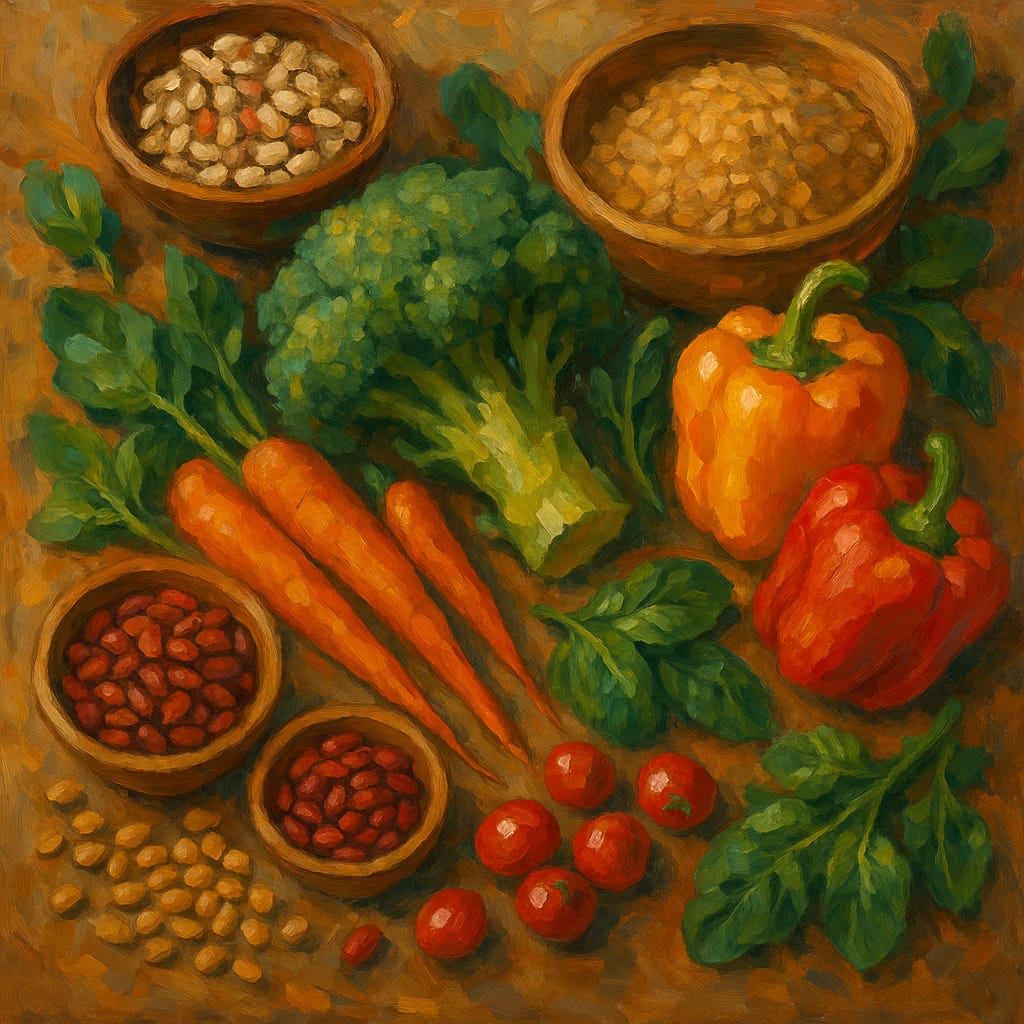
There are two main types:
Soluble fiber dissolves in water and forms a gel-like substance in your gut. This is the kind that slows digestion, helps regulate blood sugar, and can lower cholesterol. You’ll find it in oats, beans, lentils, apples, berries, and barley.
Insoluble fiber doesn’t dissolve in water. It adds bulk to your stool and helps food move through your digestive system. Think of it as your gut’s cleaning crew. You’ll find it in whole grains, vegetables like broccoli and cauliflower, nuts, and seeds.
Most plant foods contain both types, and you need both for optimal health. Your body needs both types working together - one to slow things down and stabilize your system, the other to keep things moving efficiently. You don’t need to overthink which type you’re getting, though. Just eat a variety of vegetables, fruits, beans, whole grains, nuts, and seeds, and you’ll naturally get a good mix.
The dual power of fiber: it helps you burn fat and stay full
Here’s the simple truth: fiber helps you lose weight and keep it off in two fundamental ways.
First, it helps your body optimize for fat loss. It changes how your metabolism responds to food, how your hormones communicate, and how your gut bacteria influence your weight.
Second, it makes you feel fuller and more satisfied. Not just full - actually satisfied. The kind of satisfied where you finish a meal and don’t find yourself prowling the kitchen an hour later.
Let’s start with the first way - how fiber helps your body burn fat.
How Fiber Helps Your Body Burn Fat
Understanding this requires understanding insulin and this matters more than you might think.
When you eat carbohydrates, they’re broken down into glucose (blood sugar). In response, your pancreas releases insulin into your bloodstream. Insulin acts like a key that unlocks your cells so glucose can enter and be used for energy.
When everything is working well, your cells respond quickly to insulin’s signal. The glucose gets ushered into your cells to be burned for fuel, and your pancreas only needs to produce a modest amount of insulin to get the job done.
This is called insulin sensitivity - your cells are sensitive and responsive to insulin’s signal.
But sometimes cells start to become less responsive. This happens commonly in perimenopause and menopause as estrogen levels decline. Your cells need a stronger signal to open up and let glucose in. So your pancreas has to produce more and more insulin to get the same amount of glucose into your cells.
This is insulin resistance, and it becomes increasingly common after age 40, particularly with weight gain, inactivity, and hormonal changes.
Here’s why this matters for weight loss:
Insulin is a storage hormone. When insulin levels are high in your bloodstream, your body is in “storage mode” rather than “burning mode.”
Think of it this way: high insulin levels send a clear message to your body - “We have plenty of energy available right now. Store the excess for later.” So insulin does three things that make fat loss difficult:
It signals fat cells to take up glucose and convert it to fat for storage
It blocks your body’s ability to break down stored fat for energy (why burn stored fat when there’s plenty of energy circulating?)
It keeps you in a building and storing state rather than a breaking down and burning state - the opposite of where you want to be when you’re trying to lose body fat
When you’re insulin resistant and your body is constantly pumping out high levels of insulin just to manage normal blood sugar, you’re essentially stuck in fat storage mode much of the time. Even when you’re eating fewer calories, those high insulin levels make it harder for your body to access stored fat.
This is why women often say their metabolism feels “stuck” in midlife. Your body is constantly producing elevated insulin, which is constantly telling your cells to store rather than burn.
Here’s where fiber changes the equation:
Fiber slows the absorption of carbohydrates from your digestive tract. Instead of glucose rushing into your bloodstream all at once (which would require a big insulin surge, to usher it into cells), it trickles in gradually. Your pancreas only needs to produce moderate amounts of insulin because there’s no emergency to manage.
Over time, this has a training effect on your cells. Because they’re not constantly being bombarded with high insulin levels, they stay responsive to insulin’s signal. Your insulin sensitivity improves or is maintained.
Better insulin sensitivity means:
Your body produces less insulin to manage the same amount of food
You spend more time in fat-burning mode rather than fat-storage mode
Your cells efficiently use glucose for energy instead of shuttling it into storage
You reduce fat accumulation, especially around your abdomen (belly fat is particularly linked to insulin resistance)
Studies confirm this: people who eat high-fiber diets have better insulin sensitivity and lower insulin levels, even when they eat the same amount of carbohydrates as people on low-fiber diets.
For a woman in her 40s or 50s who’s noticing weight accumulating around her middle despite eating the same way she always has, improving insulin sensitivity is crucial. Fiber is one of the most effective dietary tools for doing this.
How Fiber Feeds Your Gut Bacteria (And Why That Matters for Your Weight)
Here’s something that sounds almost too simple to be true: the bacteria in your gut influence whether you gain or lose weight. They don’t fully determine it, but they have a part to play.
The gut microbiome (the community of bacteria and other microbes in your digestive tract) can influence how your body extracts energy from food, regulates fat storage, and modulates hormones related to appetite and metabolism. Differences in gut bacteria composition have been linked to obesity, insulin resistance, and weight loss responses.
Research shows that people with more diverse gut bacteria tend to maintain healthier weights, while those with less diverse microbiomes struggle more with weight gain and metabolic issues.
Fiber is what feeds your beneficial gut bacteria.
Our colon is home to trillions of bacteria that play roles in digesting food, extracting energy, and influencing inflammation and metabolism. Different types of fiber feed different bacterial species. When you eat a variety of fiber-rich plants, you cultivate a diverse, thriving gut ecosystem.
A diverse gut microbiome is associated with healthier weight and metabolic profile, whereas an imbalanced microbiome has been linked to obesity. Those beneficial bacteria produce compounds called short-chain fatty acids that not only help regulate your appetite (more on that in a moment), but also help control inflammation and even fat storage.
There’s emerging evidence that certain gut bacteria - when properly fed with fiber - can increase levels of fat-burning hormones and reduce fat accumulation in the liver. On the flip side, a low-fiber diet starves your beneficial bacteria and leads to less desirable metabolic outcomes.
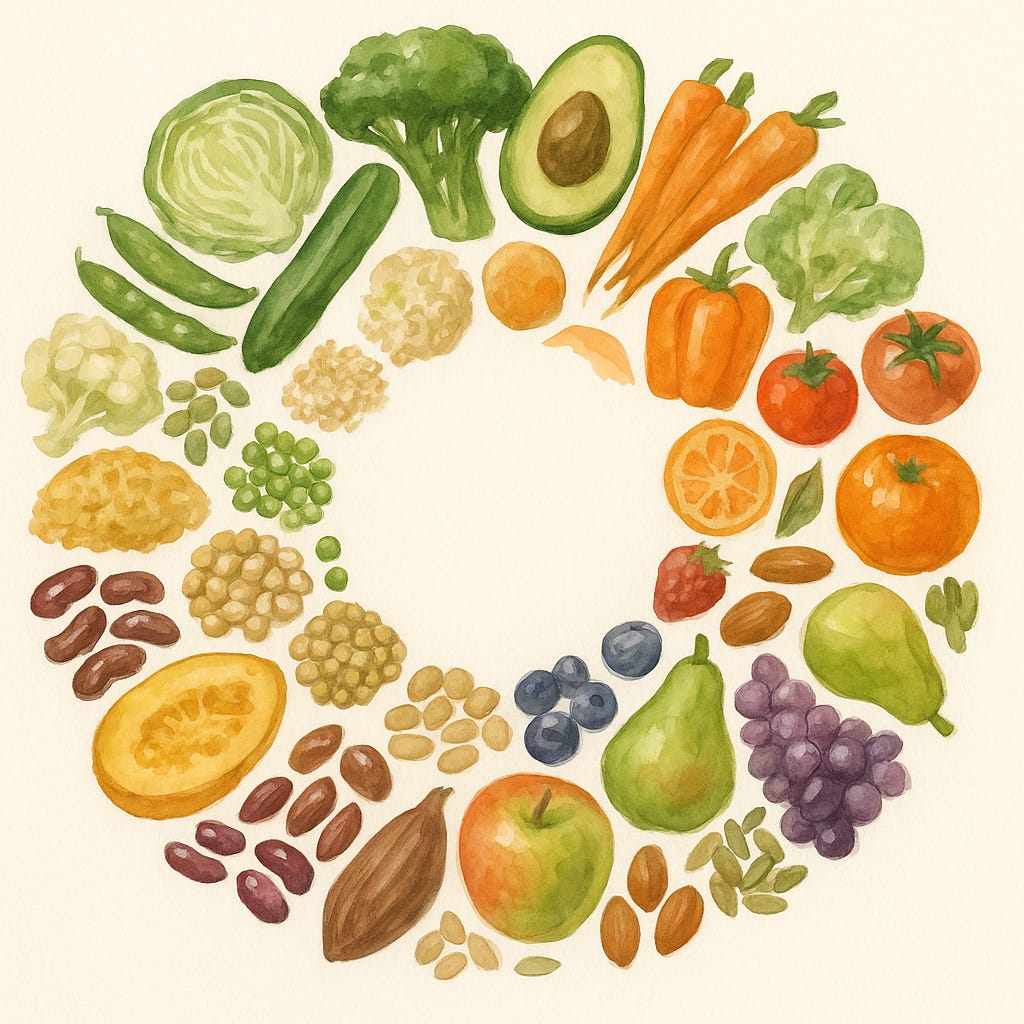
The American Gut Project found that people who ate a wide variety of fiber-rich plant foods - 30 or more different plant types per week - had significantly more diverse gut microbiomes than those who ate a more limited variety (10 or fewer plants per week). The high-variety eaters had more microbes that produce those beneficial short-chain fatty acids, which are linked to lower risk of inflammation and obesity.
Researchers even talk about an “energy harvest” effect: a fiber-rich diet may encourage bacteria that extract slightly fewer calories from food, compared to a microbiome adapted to low-fiber, high-fat diets that pulls every last calorie to make sure it’s well-fed.
The important takeaway: the more diverse fiber you eat, the more your gut bacteria thrive, and thriving gut bacteria make maintaining a healthy weight easier.
This doesn’t mean you need to eat 30 different plant foods every day. It means varying what you eat over the course of a week. Instead of having the same salad every day, rotate your vegetables. Try different types of beans. Switch up your fruits. Spices count for variety too.
How Fiber Makes You Feel Fuller and More Satisfied
Now to the second way fiber helps you lose weight - and this is where you’ll feel the difference most directly in your daily life.
Fiber controls hunger in several powerful ways.
It adds volume without calories
Foods high in fiber are typically low in energy density - meaning they provide relatively few calories per unit of weight. Think of a big bowl of salad or a plate of vegetables: it’s heavy, it fills you up, but the calorie count stays low.
This is a great weight-loss strategy. By choosing fiber-rich, low-density foods, you can eat a satisfying volume of food while naturally cutting calories. Fiber-rich fruits and vegetables are packed with water and fiber, which add volume and weight without adding calories.
Your stomach has physical stretch receptors. When it’s full, those receptors send satisfaction signals to your brain. A large salad with chickpeas might weigh 400 grams and contain 300 calories. A small muffin weighs 100 grams and also contains 300 calories. Which one makes your stomach feel fuller?
You can eat satisfying amounts of food - you just need to choose foods that deliver fullness without excessive calories. And fiber is what makes that possible.
It slows digestion and extends fullness
Soluble fiber forms a gel in your stomach that slows gastric emptying. This means food stays in your stomach longer, which means you stay full longer, which naturally leads to eating less.
Studies show that certain viscous soluble fibers - like beta-glucan from oats or pectin from fruit - increase feelings of satiety and reduce how much people eat at their next meal. Research found that adding these types of fibers to meals significantly reduced subsequent food intake.
In one 20-month study, women who increased their fiber by just 8 grams per day (less than a cup of beans) lost weight and body fat, even though they weren’t deliberately dieting. They simply weren’t as hungry, so they naturally ate less. Higher fiber intake was linked to a significantly lower risk of gaining weight or body fat over time, mostly because fiber helped them eat fewer total calories.
This is what sustainable weight loss actually looks like. Not fighting hunger. Not using willpower to resist cravings. Just genuine satiation that makes eating less feel natural rather than restrictive.
It keeps blood sugar stable
When you eat foods that are mostly refined carbohydrates without much fiber, the carbohydrates break down quickly into glucose, which floods into your bloodstream. Your blood sugar spikes. Your pancreas releases insulin to move that sugar into cells to be converted into energy. Whatever is left over gets shuttled into fat for storage. Once the glucose has been moved where it needs to go, your blood sugar drops - often falling below where it started before you ate.
That spike and crash makes you hungrier.
Your body interprets the sudden crash as an emergency. It sends urgent signals to your brain: “Glucose is low! We need food NOW!”
This is what makes you hungry and induces sudden cravings to eat. It’s why eating something like a donut or sugary cereal can make you feel very hungry shortly after. It doesn’t keep you full for long. It’s not a lack of willpower - it’s your body responding to a blood sugar crash.
To avoid this, your aim is to keep blood sugar stable - going slightly up as you eat and back down to baseline as glucose is used, but in a gentle hill rather than a sharp spike and crash.
Soluble fiber slows the absorption of sugars from your gut. By forming that gel, it slows carbohydrate digestion so glucose enters your bloodstream gradually. This leads to a smaller blood sugar spike and can improve insulin sensitivity over time. More stable blood sugar means fewer hunger swings and less frequent crash-and-crave cycles.
This is why you can eat the same number of calories and feel completely different depending on how that meal is composed. A 300-calorie muffin leaves you hungry in an hour. A 300-calorie bowl of lentil soup (with its fiber, protein, and water) keeps you satisfied for hours. Same calories. Entirely different experience.
It triggers your body’s natural appetite control system
Those three mechanisms - volume, extended fullness, and blood sugar stability - are important and impactful. But here’s where fiber really changes things.
When fiber reaches your colon, your gut bacteria ferment it, producing those short-chain fatty acids we talked about earlier. These compounds interact with specialized cells in your gut to stimulate the release of satiety hormones - specifically GLP-1 (glucagon-like peptide-1) and PYY (peptide YY).
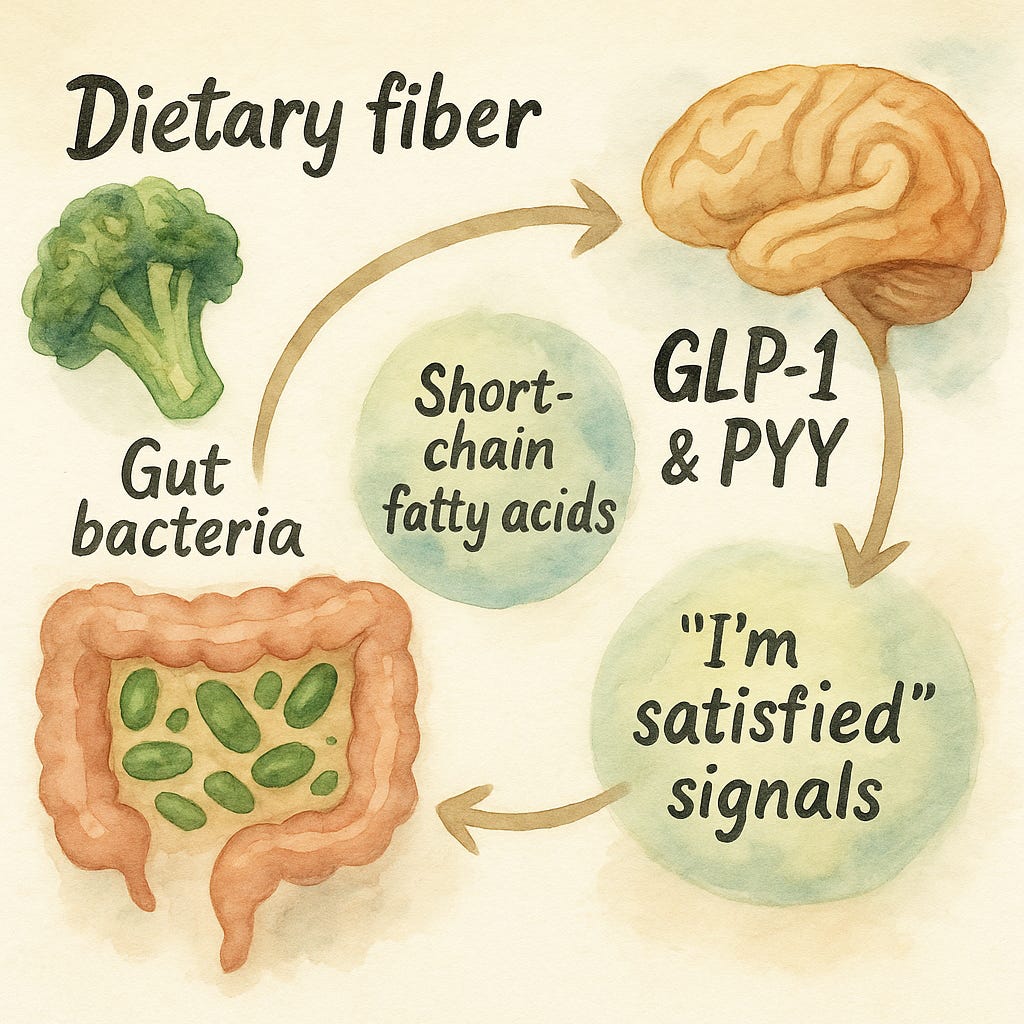
You might have heard of GLP-1 recently because of medications like Ozempic. These drugs work by mimicking this hormone to suppress appetite.
Your body produces GLP-1 naturally when you eat fiber.
GLP-1 and PYY are powerful appetite-regulating hormones. They send “I’m satisfied” signals to your brain and slow down how quickly food moves through your gut, which extends that feeling of fullness even further.
This isn’t a minor effect. One trial gave overweight adults a fiber-derived supplement that delivered propionate (one of those short-chain fatty acids) directly to the colon. It significantly increased GLP-1 levels and reduced appetite, leading participants to eat less at a buffet meal without trying. Over six months, those getting the extra propionate had lower body weight and less abdominal fat than the control group.
In other studies, simply adding fermentable fiber like inulin or resistant starch to the diet for a few weeks increased people’s satiety after meals and reduced their overall daily calorie intake - likely thanks to these gut hormones.
Fiber works internally to boost your body’s own appetite-suppressing signals, similar to how weight-loss medications target GLP-1.
This natural hormone effect is a big reason why higher fiber diets are consistently linked with easier weight control.
When you combine enough protein with adequate fiber, these two nutrients work together to optimize every meal for fullness and satisfaction. They’re your two most powerful tools for natural appetite control.
Why This Matters Even More After 45
If you’re in perimenopause or postmenopause, everything I’ve described becomes even more important.
As estrogen declines, several things happen that make weight gain easier and weight loss harder:
Estrogen used to help suppress your appetite. Without as much of it, hunger signals get stronger. You might find yourself genuinely hungrier than you used to be, even when eating the same amount.
Your metabolism naturally slows down - partly from aging, partly from hormonal changes, partly from losing muscle mass (another byproduct of declining estrogen, if you don’t counter it with strength training and sufficient protein).
Fat storage patterns shift. You’re more likely to gain weight around your middle rather than your hips and thighs as estrogen goes down and with it, insulin sensitivity often declines.
This is why the same eating habits that maintained your weight in your 30s lead to weight gain in your 40s and 50s. It’s not your imagination, and it’s not your fault.
Fiber helps counteract these changes.
It provides satiety support when estrogen isn’t doing that job as effectively anymore. Those GLP-1 and PYY hormones we talked about? They help regulate appetite even when your estrogen levels are lower.
Fiber also influences how your body metabolizes estrogen. Your gut bacteria play a role in breaking down and eliminating estrogen. A fiber-rich diet supports this process, which can help with estrogen balance and potentially ease estrogen dominance symptoms like bloating and weight gain.
One study found that postmenopausal women who increased their fiber intake by about 10 grams per 1000 calories had a significantly lower risk of metabolic syndrome - a cluster of conditions including high blood pressure, high blood sugar, excess abdominal fat, and abnormal cholesterol that together increase the risk of heart disease, stroke, and type 2 diabetes.
Another study showed that a modest increase in dietary fiber - just 3% of daily calories - could help prevent midlife weight gain.
This isn’t about needing extreme measures. It’s about small, strategic changes that work with your changing physiology rather than against it.
The Health Benefits That Really Matter
Beyond weight loss, fiber does other things that matter for health in midlife. These aren’t separate issues - they’re all connected. When you address your weight and insulin sensitivity, you often improve these other markers too.
LDL cholesterol often creeps up after menopause because you’re losing estrogen’s protective effect. Soluble fiber - the kind in oats, beans, barley, and apples - binds to cholesterol in your digestive tract and helps remove it. This isn’t a minor effect; it can reduce LDL by 5-10%.
Inflammation tends to increase with age and hormonal changes. Chronic inflammation makes weight loss harder and increases disease risk. High-fiber diets reduce inflammatory markers in the body.
Blood pressure and cardiovascular health improve with higher fiber intake. This matters because heart disease risk increases significantly for women after menopause.
When you prioritize fiber as part of a balanced diet, you’re not just working on weight loss. You’re supporting your overall health in ways that compound over time.
How to Easily Incorporate Fiber Into Your Meals
By now, hopefully you’re convinced that fiber should be a crucial part of your diet. Here’s the thing that often gets lost in all the noise on social media and in the press: it’s not one thing or another. In nutrition, it’s all about the “and.”
You can’t isolate results to one factor. You need to understand the role of different nutrients and elements and bring them all together to achieve the results you’re after. This is why some days everyone talks about protein and other days it’s fiber. All these elements work together. When you make sure your nutrition choices cover all bases, you’re setting your biology up to work with you, not against you.
Here’s a practical framework for incorporating fiber into every plate:
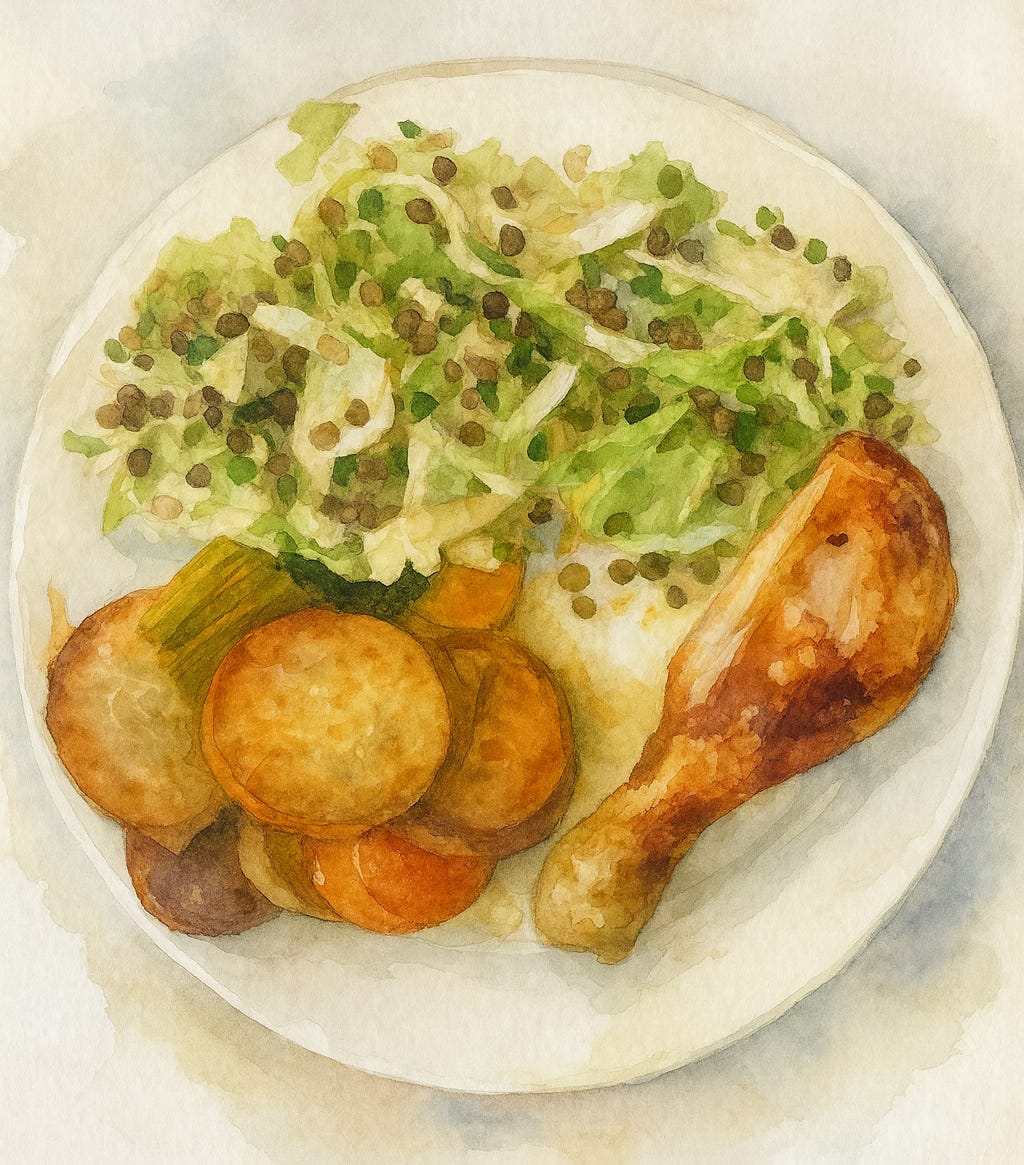
Start with protein. This is your foundation (see the complete protein guide here) - chicken, fish, tofu, eggs, Greek yogurt. Around a quarter of your plate.
Add a small serving of beans or lentils. Even if you’re also having meat or fish, try to include some beans or lentils as part of your meal. This might be a scoop of chickpeas on your salad, black beans with your eggs, or white beans in your soup. More about why beans are such a powerhouse below.
Fill half your plate with vegetables. Roasted, steamed, sautéed, raw - however you enjoy them. Mix colors and types for variety throughout your meals. Lots of fiber, lots of micronutrients, low calorie density - which means volume for fewer calories.
The rest of your plate - around a quarter or less - can include whole grains and some healthy fats. Avocado, olive oil, nuts, seeds, a tablespoon of chia or ground flax on your yogurt, nuts sprinkled on your salad - all abundant in fiber.
You might have noticed that almost every category on this plate, except the protein and some fats, includes good amounts of fiber. That’s intentional. We’re optimizing for fiber whenever we eat.
What does this look like in practice?
Breakfast: Greek yogurt with berries and a tablespoon of chia seeds. Maybe some almonds.
Lunch: Big salad with mixed greens, chickpeas, grilled chicken, lots of colorful vegetables, and avocado.
Dinner: Salmon with roasted Brussels sprouts and carrots, plus a side of white beans cooked with garlic and herbs. Small serving of quinoa if you want it.
Snacks: Apple with almond butter. Raw vegetables with hummus. A handful of nuts.
You’d easily get 30-35 grams of fiber this way, plus abundant protein and nutrients. And you wouldn’t feel deprived or hungry.
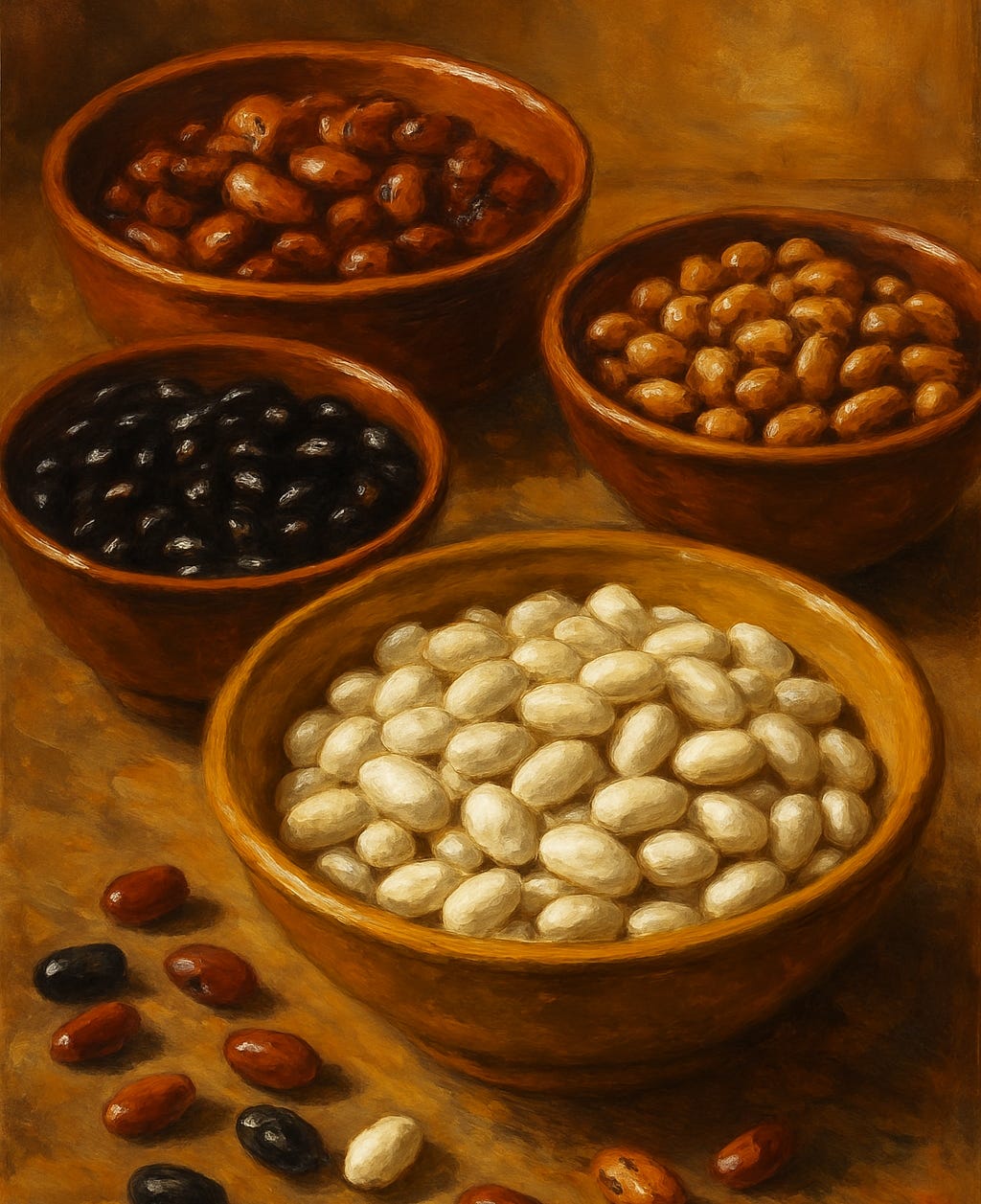
Why Beans Deserve Special Attention
Let me make a specific case for beans and lentils, because I think they’re the most underutilized weight loss tool available.
Beans are remarkable:
15-16g fiber per cup
15-18g protein per cup
Rich in iron, magnesium, folate, potassium
Extremely low in calories for how filling they are
Inexpensive and shelf-stable
That combination of fiber and protein keeps you satisfied for hours. Your blood sugar stays stable. You don’t get hungry again quickly. They’re genuinely one of the best foods you can eat for weight management.
“But beans make me bloated.”
This is common if you’re not used to eating them. Your gut bacteria need time to adapt. Start with a quarter cup of well-cooked beans and increase gradually over a few weeks. Make sure they’re cooked thoroughly.
Any initial gas or bloating typically resolves within a week or two as your gut bacteria adjust. The long-term benefits are worth the brief adaptation period.
Ways to include beans:
Add chickpeas or white beans to salads
Make bean-based soups
Use black beans in tacos or grain bowls
Add lentils and beans to meat in bolognese or other meat-based meals
Blend white beans into smoothies (they’re virtually tasteless)
Mash chickpeas for a sandwich filling
Use any beans with spices and vegetables to make your own version of hummus
Practical Tips for Increasing Fiber (Without the Discomfort)
Making the shift to a higher-fiber diet doesn’t have to be complicated or uncomfortable. Here’s how to do it right:
Start slowly and build gradually
Don’t jump from 10 grams of fiber per day to 35 grams overnight. Your digestive system needs time to adapt. Add about 5 grams every few days and give your body 3-4 days to adjust before adding more.
This might look like:
Week 1: Add berries to your breakfast (4-5g extra)
Week 2: Include a side salad with lunch (3-4g extra)
Week 3: Add a serving of beans to dinner (7-8g extra)
Week 4: Switch from white rice to quinoa or brown rice (3-4g extra)
This is especially important if you know you have a sensitive digestive system. If you’re experiencing lots of bloating and uncomfortable gas that doesn’t improve with time, see a healthcare professional to rule out possible digestive issues like IBS.
Drink plenty of water
This is essential, not optional. Fiber pulls water into your digestive tract - that’s how it works to keep you regular and create that gel-like substance that contributes to fullness. Without adequate water, you’ll end up constipated rather than comfortable. Aim for at least 8 glasses of water daily, more if you’re active or it’s hot out.
Choose nutrient-dense fiber sources
Not all fiber sources offer the same nutritional value. Your goal isn’t just to hit a fiber number - it’s to nourish your body so completely that it stops fighting to hold onto weight.
Here’s how to prioritize:
Best choices - beans and lentils:
15-16g fiber per cup
15-18g protein per cup
Rich in iron, magnesium, folate, potassium
Examples: black beans, chickpeas, lentils, white beans, kidney beans
Excellent choices - vegetables:
High in fiber, vitamins, and minerals
Very low in calories relative to volume
Priority picks: leafy greens (spinach, kale, collards), cruciferous vegetables (broccoli, Brussels sprouts, cauliflower), artichokes, carrots, bell peppers
Great choices - fruits:
Good fiber plus vitamins and antioxidants
Natural sweetness that satisfies cravings
Best options: berries (raspberries, blackberries, strawberries), apples, pears, oranges, avocados (lower in sugars)
Smart additions - nuts and seeds:
Provide fiber plus healthy fats, protein, and minerals
Calorie-dense, so watch portions
Top picks: chia seeds, ground flax, almonds, pumpkin seeds
Supporting players - whole grains:
Better than refined grains, but less nutrient-dense than beans and vegetables
Good options: oats, quinoa, barley, brown rice
Keep portions moderate and let vegetables take center stage on your plate
Aim for variety - the 30 plants rule
Different types of fiber feed different beneficial gut bacteria. If you eat the same fiber sources every single day, you’re essentially feeding only certain bacterial species while starving others.
Try to eat 30 or more different plant foods over the course of a week. This includes:
All vegetables (each type counts separately)
All fruits
All legumes (beans, lentils, peas)
All whole grains
All nuts and seeds
Herbs and spices
You don’t need to track this obsessively. Just make it a habit to rotate what you’re eating rather than having the exact same meals every week.
Instead of always having spinach salad, rotate through different greens. Try different types of beans. Switch up your fruits. Use various nuts and seeds. Experiment with new vegetables.
Prioritize whole foods over supplements
Fiber supplements like psyllium husk or inulin powder can be helpful in some cases, especially if you’re struggling to get enough through food alone. But whole foods give you so much more than just fiber.
An apple provides fiber plus vitamin C and quercetin. A cup of lentils gives you fiber plus protein, iron, and folate. A serving of broccoli delivers fiber plus vitamins K and C, folate, and beneficial plant compounds.
A supplement just gives you fiber.
Use supplements as a backup or a top-up if needed, but don’t rely on them as your primary source.
Aim for 30 grams a day
Aim for 25-30 grams minimum, ideally 30-35 grams per day.
Surveys show that most women get 10-15 grams of fiber per day. That’s not enough to see the metabolic and appetite benefits we’ve discussed.
You don’t need to track obsessively, but it helps to understand which foods contribute how much fiber so you can make informed choices.
What does 30 grams look like?
Breakfast: Oatmeal with berries and chia seeds (8g)
Snack: Apple (4g)
Lunch: Large salad with chickpeas and vegetables (10g)
Snack: Carrots with hummus (3g)
Dinner: Salmon with roasted vegetables and quinoa (6g)
Not complicated. Not restrictive. Just thoughtful food choices.
The Real Reason This Works
Prioritizing fiber within your diet works not because fiber is magic, but because it addresses the actual reasons weight loss is hard.
Weight loss fails when you’re reducing calories and as a result:
You’re eating less and feeling constantly hungry
Your blood sugar is unstable, which creates more cravings and hunger
Your hormones are working against you, trying to make sure you eat more to satisfy physiological needs
Your body feels deprived of nutrients and keeps looking for more food
You can’t sustain eating less long-term
Fiber helps with all of these.
It keeps you satisfied so you’re not battling hunger. It stabilizes blood sugar so you’re not on a roller coaster that induces constant cravings. It supports hormone balance, especially important in midlife. It comes packaged with the nutrients your body needs. And it’s completely sustainable because you’re eating real food, not following rigid rules.
Combined with sufficient protein intake and regular exercise, fiber can transform your efforts to lose or maintain a healthy weight - making them more comfortable, easier, and longer-lasting.
This is about working with your body’s natural systems rather than fighting against them.
Where do you start?
You don’t need to overhaul everything at once. Small changes compound over time.
Pick one or two things to start:
Add berries and ground flax to your morning yogurt
Include a large salad with lunch most days
Add beans to dinner twice this week
Switch one refined grain for a whole grain
Bring cut vegetables and hummus as your afternoon snack
Do that for a week or two until it feels normal. Then add another small change.
The goal is progress, not perfection. You’re building habits that will serve you for years, not just following another temporary diet.
Your body has the capacity to regulate appetite, burn fat efficiently, and maintain a healthy weight. Fiber is one of the tools that helps activate those natural processes.
It’s not flashy. It won’t be featured in dramatic before-and-after posts. But it works, quietly and effectively, in a way that you can sustain for the long term.
And sometimes the most powerful changes are the ones that don’t feel like deprivation or struggle. They just feel like finally giving your body what it’s been asking for all along.
🌸Thanks for reading! I’m building this space for women who want the knowledge and inspiration for healthy, sustainable and sane weight loss, for life.
💭Tell me in the comments what clicked for you in this post or topics you’d love to read more about.
💌Forward this post to someone who needs some inspiration and support on their journey.