

You can’t escape the protein talk. Open Instagram and you’ll see protein shakes, meal prep posts, and reels showing you how to cram more than 100 grams of protein into 1500 calories, 3 meals and two snacks a day.
The message is clear: eat your protein! But if you’re like most people, you’re probably wondering: why does protein actually matter? How much do you really need? What happens if you don’t eat enough? Does it genuinely help with weight loss? And why is it supposed to be extra important for women in their 40s and beyond?
There’s so much information out there - some of it contradictory, much of it focused on what to do without explaining the why.
There’s a difference between blindly following guidelines and actually understanding how they help you achieve your goals. When you get why something matters, you’re far more likely to stick with it. It stops being just another rule you’re supposed to follow and becomes a tool you actually want to use.
This guide brings it all together. We’ll go back to basics and explain what protein actually does in your body, how it can help you on your weight loss journey, and why it becomes more critical as you age. We’ll also tackle the questions you’re probably wondering about: plant versus animal protein, whether timing matters, how much you really need, how to structure your meals to hit your goals, and why balance beats perfection every time.
By the end, you’ll understand not just what to do, but why - so you can make protein work for you.
Let’s start with the basics.
What Is Protein?
Protein is one of three macronutrients (along with carbs and fats) that make up food. At the risk of oversimplifying: carbs fuel your activities, fats provide energy storage and regulate hormones, and protein builds and repairs your body.
Proteins are made of amino acids - 20 different building blocks. Your body breaks down the protein you eat into these blocks, then uses them to repair tissues, build muscle, make enzymes and hormones, and keep your immune system working. Different proteins contain different combinations of these amino acids. The body breaks down the proteins you consume through digestion into their various amino acids and uses them as needed.
Common protein foods include: chicken, fish, beef, eggs, Greek yogurt, cottage cheese, milk, tofu, tempeh, lentils, chickpeas, black beans, quinoa, nuts, and seeds. But many other foods also have protein in them, including vegetables, fruits, and foods you think of as carbs or fats. They just contain protein in lower quantities, which is why they’re not considered protein sources.
Why Protein Matters for Weight Loss
At the most basic level, protein helps you in your weight loss journey by supporting both sides of the weight loss equation:
calories consumed < calories burned = weight loss.
Reduce how much you eat, or burn more calories at rest or through activity and exercise, and you’ll find yourself in a calorie deficit and lose weight. Or more precisely, we want to lose fat and and maintain or build muscle. And protein helps us do just that.
Protein works on both sides of the equation. It helps you eat less by keeping you full, and it helps you burn more calories through its thermogenic effect and by supporting muscle mass.
Protein and Appetite: how to feel full and satisfied on fewer calories
Different foods affect your hunger differently. Protein helps keep you full and satisfied for longer than carbs or fats. Different foods impact our blood sugar levels which in turn affect our cravings, and they take different amounts of time to digest, which affects how long we stay full.
Protein helps keep your blood sugar stable, which directly helps you manage your hunger. Here’s why: when you eat refined carbs (like white bread or sugary snacks) on their own, they get digested quickly and your blood sugar spikes up fast, then crashes down just as fast. Those crashes make you feel hungry and cranky, and suddenly you’re craving more food an hour later.
But when you eat protein, it slows down digestion. Your food takes longer to move through your stomach, which means the sugar from your meal enters your bloodstream more gradually. No spike, no crash - just steady energy. This steadier blood sugar means you stay fuller for longer and don’t get those intense cravings that send you looking for snacks between meals.
Even more importantly, when you eat protein and your gut digests it, your body releases hormones that travel to your brain and signal “I’m full,” known as satiety hormones like peptide YY and GLP-1, while at the same time suppressing ghrelin, the hormone that signals hunger. Eating protein literally creates a double effect: more fullness signals plus fewer hunger signals. Your body’s biology is telling your brain - we got what we need, we’re good, no need to eat more.
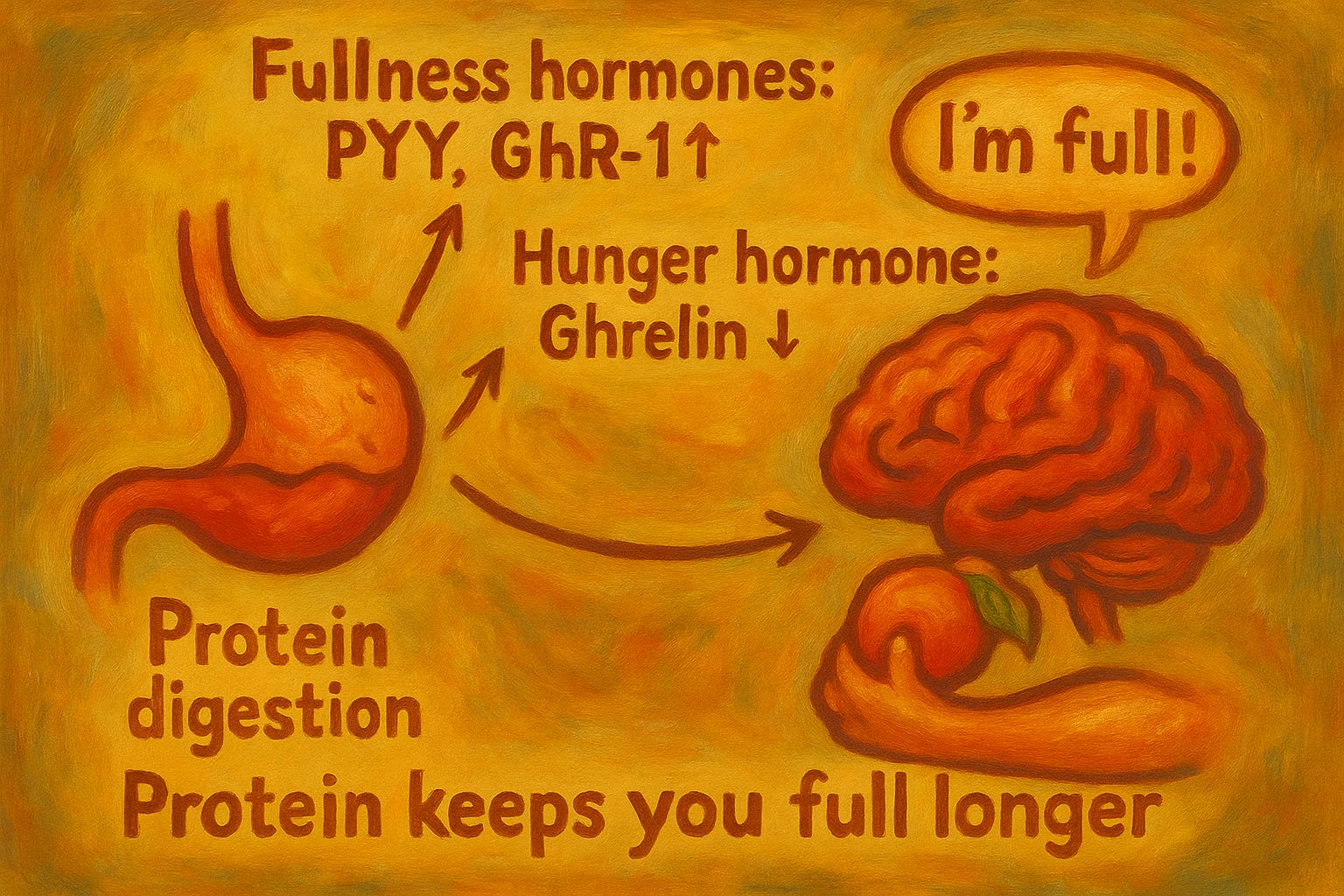
In practice, this means if each meal has enough protein, you’ll feel full longer and won’t need to eat again as soon.
So if you prioritise consuming adequate levels of protein, you will feel fuller and more satisfied, it will be easier to eat less and the process of losing weight will become less of a struggle. You will be working with your biology instead of against it.
Here’s the thing: managing your hunger and satiety cues (how full and satisfied you feel) is one of the key determinants of whether you’ll succeed at weight loss (and in maintaining your new weight).
If you’re constantly hungry and unsatisfied, you will eventually give up - not because you’re weak, but because going against hunger (one of our most basic drives) is nearly impossible.
Even if you manage it for a while, it won’t last. Eventually the urge to eat will win.
But if you learn how to feel full and satisfied on fewer calories, you will be playing a different game. Now you’re not fighting your body, you’re working with it. And adequate protein consumption is one of the best tools we have to do that.
Why Not Eating Enough Protein May Drive You to Overeat
One strong theory as to why protein impact hunger and satiety so strongly is the protein leverage hypothesis. The idea behind it is that humans have an inherent drive to reach a certain level of protein intake.
The hypothesis claims that If your diet is low in protein, your body keeps pushing you to eat more food to meet its protein needs, even if that means you end up eating way more calories than you need from carbs and fats. Your body basically says “keep eating until we get enough protein.”
But when you eat more protein, your appetite goes down naturally because your protein needs are satisfied earlier. This is still a theory - it remains contentious among nutrition scientists - as it is based mostly on animal studies and limited human trials.
Hunger is complicated and affected by many things beyond just protein, and not everyone accepts it as the sole driver. But it shows something important: protein can be a big lever when trying to lose weight, because of its impact on hunger.
The Other Side of the Equation: Metabolism and Calories Burned
Now let’s talk about the other side of weight loss: calories burned.
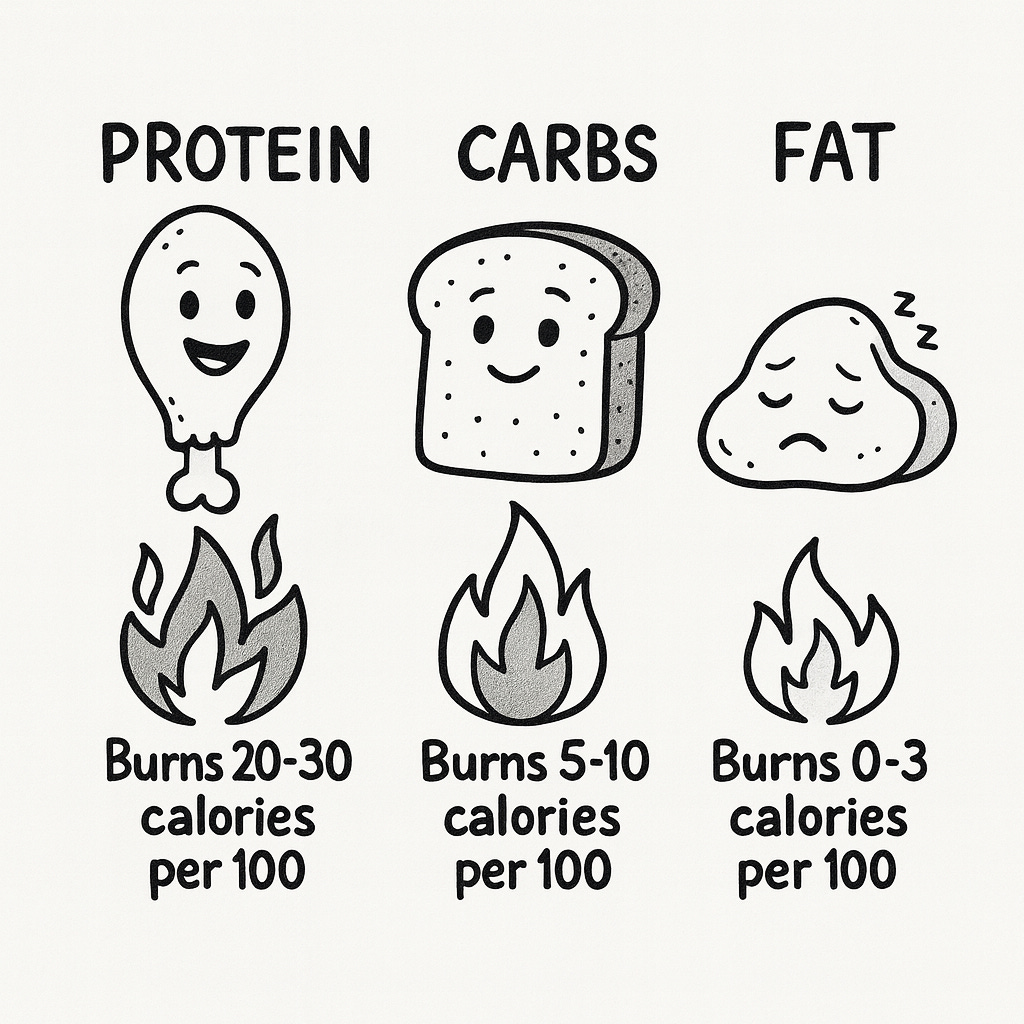
Every food we consume has a thermogenic effect. Your body burns calories just to digest and process what you eat. Protein requires more energy to break down than other nutrients.
When you eat 100 calories of protein, your body uses about 20-30 of those calories just handling the digestion process. Compare that to carbs (which use about 5-10 calories per 100 eaten) or fats (which barely use any, maybe 0-3 calories). So yes, you’re burning a few extra calories simply by choosing protein-rich foods.
Is this going to revolutionize your weight loss on its own? No. We’re talking maybe 50-100 extra calories burned per day if you’re eating a high-protein diet. But when you’re working on creating a calorie deficit, every bit helps, and it’s just one more way protein works in your favor.
The Muscle-Metabolism Connection: Why Protein Helps You Burn More
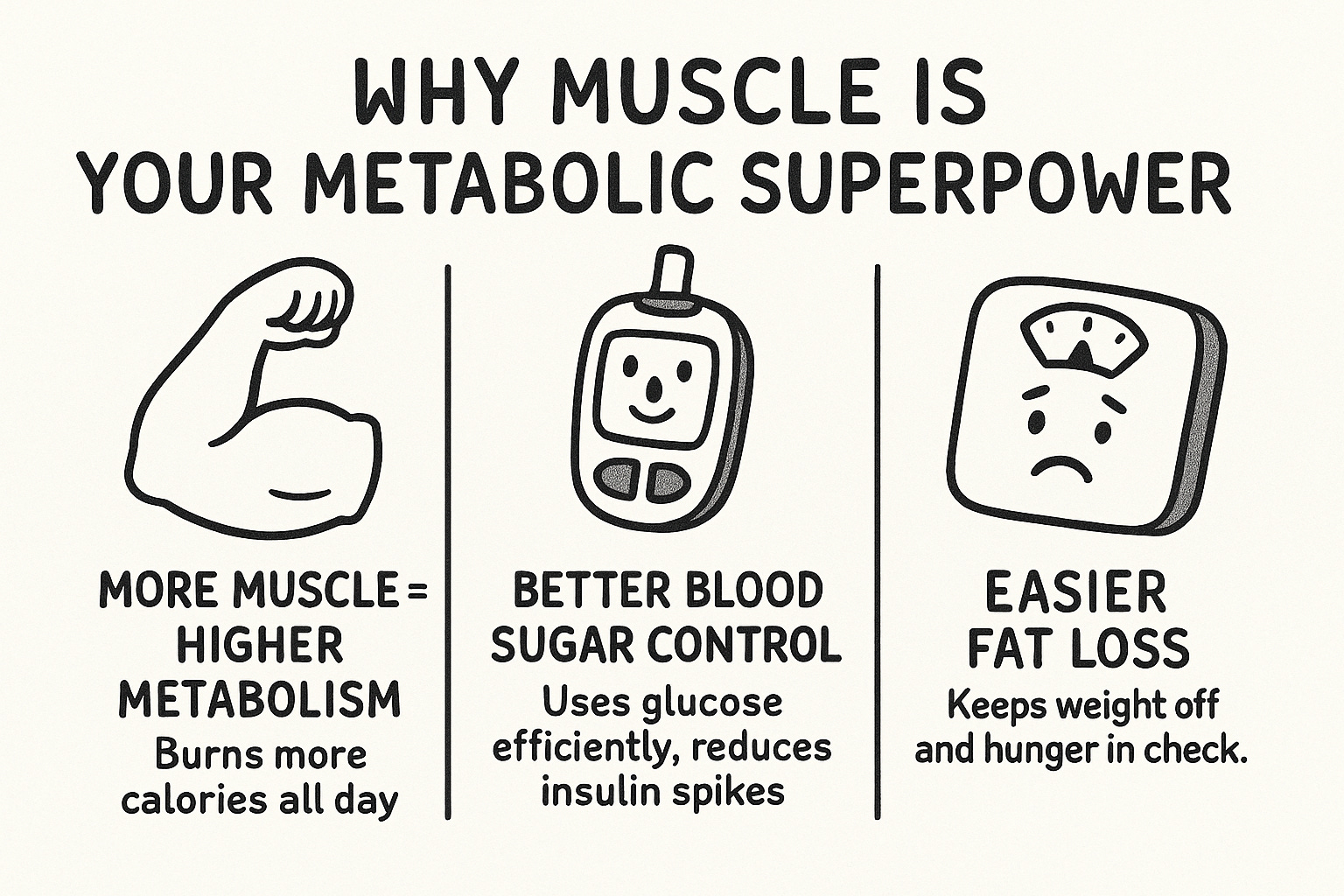
Your body burns calories even when you’re sitting still - this is your resting metabolic rate, the energy needed to keep everything running. Your heart beating, lungs breathing, cells dividing and repairing. The more metabolically active tissue you have, the more calories you burn at rest.
Muscle is more metabolically active than fat. Muscle needs energy to maintain itself because muscle tissue is constantly being broken down and rebuilt, which takes calories to do. This is even more pronounced if you’re engaged in resistance training or weight lifting as exercise triggers increased breakdown during workouts and rebuilding during recovery. Fat needs much less energy to maintain.
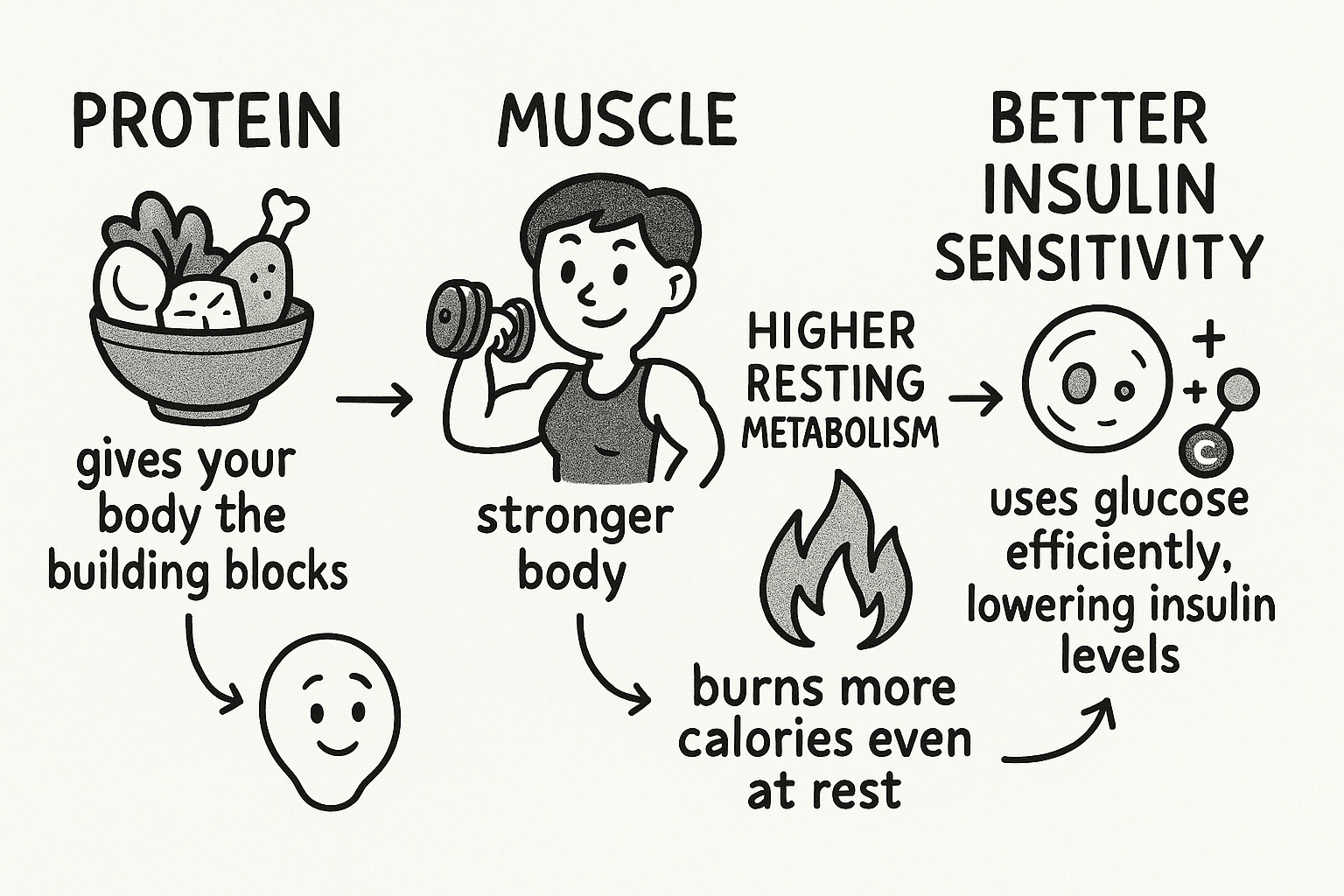
In order to support muscle maintenance and growth, we need the right building blocks - amino acids, which come from protein. The more muscle you have, the more energy your body needs to maintain it. This translates to a higher resting metabolic rate, which essentially means you burn more calories 24/7 to keep your body alive, even while you sleep.
Now, the direct effect of gaining more muscle on the number of calories you’re burning isn’t huge. We know from research that muscle burns about 13 extra calories per kilogram per day at rest compared to fat. So if you gain 2 kilograms of muscle, that’s roughly 26 extra calories burned per day. Not very exciting.
But the biggest benefit is indirect. The stronger you are, the harder you can train and the more calories you burn when you’re active. Muscle improves your metabolic health (how efficiently your body processes and uses energy) and increases your body’s ability to handle glucose and fat. This means that as you eat, sometimes imperfectly, your body is more efficient and resilient to consumption of higher amounts of sugar, carbs, and fat. The more metabolically active your body is, the lower your risk of diabetes, obesity, and heart disease.
When you’re trying to create a calorie deficit, all this adds up. You’re eating less because protein keeps you full, and you’re burning more because muscle is active and supports you in being more active (more energy, means better ability to exercise harder and burn more calories).
More Protein > More Muscle > Better Weight Management
Muscle also improves your insulin sensitivity, which naturally reduces in your 40s and beyond, creating a valuable buffer for health. Here’s why this matters for weight loss: insulin is the hormone that helps your body handle the carbs you eat by moving sugar from your blood into your cells for energy or storage. When you have good insulin sensitivity, your body only needs a small amount of insulin to do this job efficiently.
But when insulin sensitivity decreases (which happens with age, especially during menopause), your body has to pump out more and more insulin to handle the same amount of carbs. High insulin levels make it really hard to lose weight because insulin is essentially a storage hormone - it tells your body to store energy as fat rather than burn it. High insulin also makes you hungrier and can trigger cravings, particularly for carbs and sugar.
The good news is that muscle acts like a glucose sponge - it absorbs and uses sugar from your blood, which means your body doesn’t need to produce as much insulin. Better insulin sensitivity means lower insulin levels overall, which makes it easier to burn fat, reduces cravings, and helps prevent weight gain.
Between the thermogenic effect, muscle support, and better insulin sensitivity, you can see why protein is a really useful tool in the process of losing weight - losing fat, specifically. While calorie deficit remains the primary driver of weight loss, better insulin sensitivity makes the process easier and more sustainable.
And it helps with maintenance as well. Studies show high-protein diets make it easier to keep weight off. Because if you eat enough protein, you’re not just losing weight - you’re changing your body in a way that makes it more efficient at burning energy (read: calories). You’re fuller so you eat less, which together makes maintenance easier.
Fat Loss vs. Muscle Loss
When you lose weight, you don’t just lose fat - you also lose muscle. When we say we want to lose weight, what we really want is to have less fat and ideally increase the amount of muscle we have.
Losing muscle while you diet makes everything harder. It slows your metabolism (because the less muscle you have, the fewer calories you burn), it makes you weaker, and you end up looking soft rather than lean, even if the scale shows a lower number.
Aesthetically, the more muscle you have and the less fat you have, regardless of the number on the scale, you’ll look leaner and more toned. With less padding, you can see the shape of your body, and muscle takes up less space than fat, so the overall appearance is that you look smaller and more toned.
I have clothes I bought when I lost weight in previous attempts that would only fit me at a certain weight. This time around, as I’m also doing resistance training and lifting weights at the gym, the same clothes fit me despite weighing more than I weighed when I last bought them. So I’m weighing more on the scale, but the clothes fit better. Why? Because my body composition has changed - more muscle, less fat, meaning a leaner, more toned-looking body.
But this isn’t just about looks. Keeping your muscle mass and making sure you have enough of it is about your health, strength, mobility, and quality of life as you age. So regardless of how happy you are with the way you look, building and maintaining muscle for life will support your long-term health and function.
Now that we’ve established that maintaining and building muscle during weight loss is important, let’s go back to protein. Studies show that eating more protein during weight loss helps you lose fat while keeping muscle (as the building blocks of protein support muscle maintenance and growth over breakdown), which means any weight lost comes from losing fat, not muscle - which is what we want.
Higher protein consumption in a calorie deficit helps you lose fat while protecting muscle. This keeps your metabolism from becoming less efficient and leads to better body composition. You end up stronger and leaner, not just weighing less.
Think about this: two people lose the same 10 kilograms (22 lbs, 1.6 stones), but one eats enough protein and the other doesn’t. They end up with completely different bodies. The high-protein person loses mostly fat and keeps muscle, ending up lean and strong. The low-protein person loses both fat and muscle, ending up weaker with a slower metabolism and higher body fat percentage, even at the lower weight.
Protein, Muscle, and Exercise
Interesting research shows that eating enough protein helps maintain muscle, even without exercise. If you’re eating enough protein in a calorie deficit, you’ll lose less muscle than someone who doesn’t.
But if you want to actually build muscle, or keep as much as possible during weight loss, you need both protein and resistance exercise. Resistance training (weight lifting, bodyweight exercises, resistance bands) tells your body “There’s hard activity going on, we need these muscles - keep them or build more.” And protein gives your body the materials to respond to that signal. Doing one without the other leads to less than ideal results.
For women later in life, this combination is particularly powerful. Studies show that resistance training improves muscle mass, strength, and bone density in middle-aged and older women, counteracting the typical declines of aging. When you combine strength training with enough protein, you give both the signal (exercise) and the materials (protein) your muscles need to get stronger.
For weight loss, this combination is valuable because building or keeping muscle through strength training ensures the weight you lose comes from fat, not muscle. You end up with a stronger body and better function in daily life. Stronger muscles support your body better in daily activities, which means less joint pain, less likelihood of frozen shoulder in menopause, better posture, and as you get older, less frailty and more mobility.
There are so many benefits to building muscle and I can’t think of a single reason not to do it.
Research on middle-aged women who do resistance training and eat enough protein shows improvements in body composition and strength, which helps with both weight loss and long-term health.
And all of this becomes even more important as you get older and move into perimenopause, menopause, and beyond.
Why Protein Becomes More Critical in Your 40s
Everything so far applies to everyone, but for women in their 40s and beyond - especially during perimenopause or menopause - protein (and resistance training) becomes critical.
Starting in your 40s and 50s, you naturally start losing muscle and gaining fat, partly because of changing hormone levels. With lower estrogen levels, the body sends fewer muscle-building signals (such as growth hormone and IGF-1), resulting in more muscle breakdown and inflammation. More muscle breakdown and less muscle building means the balance between muscle and fat in your body shifts.
As a result, women lose muscle and strength faster around menopause, and they often gain more body fat. Muscles become less efficient as metabolic engines, insulin sensitivity goes down and more fat is stored.
When you hear women saying their body started changing shape or they started gaining weight despite doing the exact same things they were doing before, or if this is you - this could be the reason. You’re not imagining it - it’s a metabolic shift driven by hormones.
Beyond weight, these changes affect health and quality of life. Loss of muscle and bone increases risk of frailty, falls, and osteoporosis as you get older.
How Protein Helps During the Menopause Transition
This is where protein (and resistance training) become your best tools during this transition. Getting enough protein helps offset the muscle loss from menopause. Having enough amino acids circulating in your body to repair and build muscle matters even more when your body’s muscle-building efficiency is lower. Some experts suggest women in perimenopause need more protein than younger adults to maintain the same amount of muscle.
Remember the protein leverage hypothesis? As hormones accelerate muscle breakdown, your body is looking for more protein. If you don’t increase protein, your body may push you to eat more of other foods to meet its protein needs. So not enough protein could lead to overeating fats and carbs, causing additional weight gain.
Research from the University of Sydney suggests women’s appetite for protein increases in perimenopause, and if protein needs aren’t met, they may eat excess calories trying to satisfy that protein hunger. By eating more protein, you avoid that trap - you satisfy your body’s needs and feel full on fewer calories.
Another factor is that overall energy expenditure can drop during menopause (from having less muscle and from potentially being less active). This means without changing your diet, weight gain happens more easily.
But here’s some good news: small changes can make a real difference. Research suggests that increasing your protein intake by just a few percent while cutting back a bit on sugars and saturated fats could help prevent that midlife weight creep. This is based on observational studies, not clinical trials but it’s a positive signal that we’re not talking about a complete diet overhaul - just modest adjustments.
Realistically, this could mean replacing a sugary snack with Greek yogurt, or having a larger portion of lean protein at meals instead of extra bread or pasta. The goal is to give your body what it wants (protein) while avoiding unnecessary calories.
Beyond weight, protein is crucial for health at this time of life. It supports muscles and bones, which help maintain your strength and mobility as you age. Combined with resistance exercise, more protein can improve muscle mass and function in postmenopausal women. When you combine strength training with enough protein, you give both the signal and the raw materials for muscles to grow stronger.
Even if building big muscles isn’t your goal, keeping the muscle you have will keep you metabolically healthy and more likely to stay active and energetic as you age.
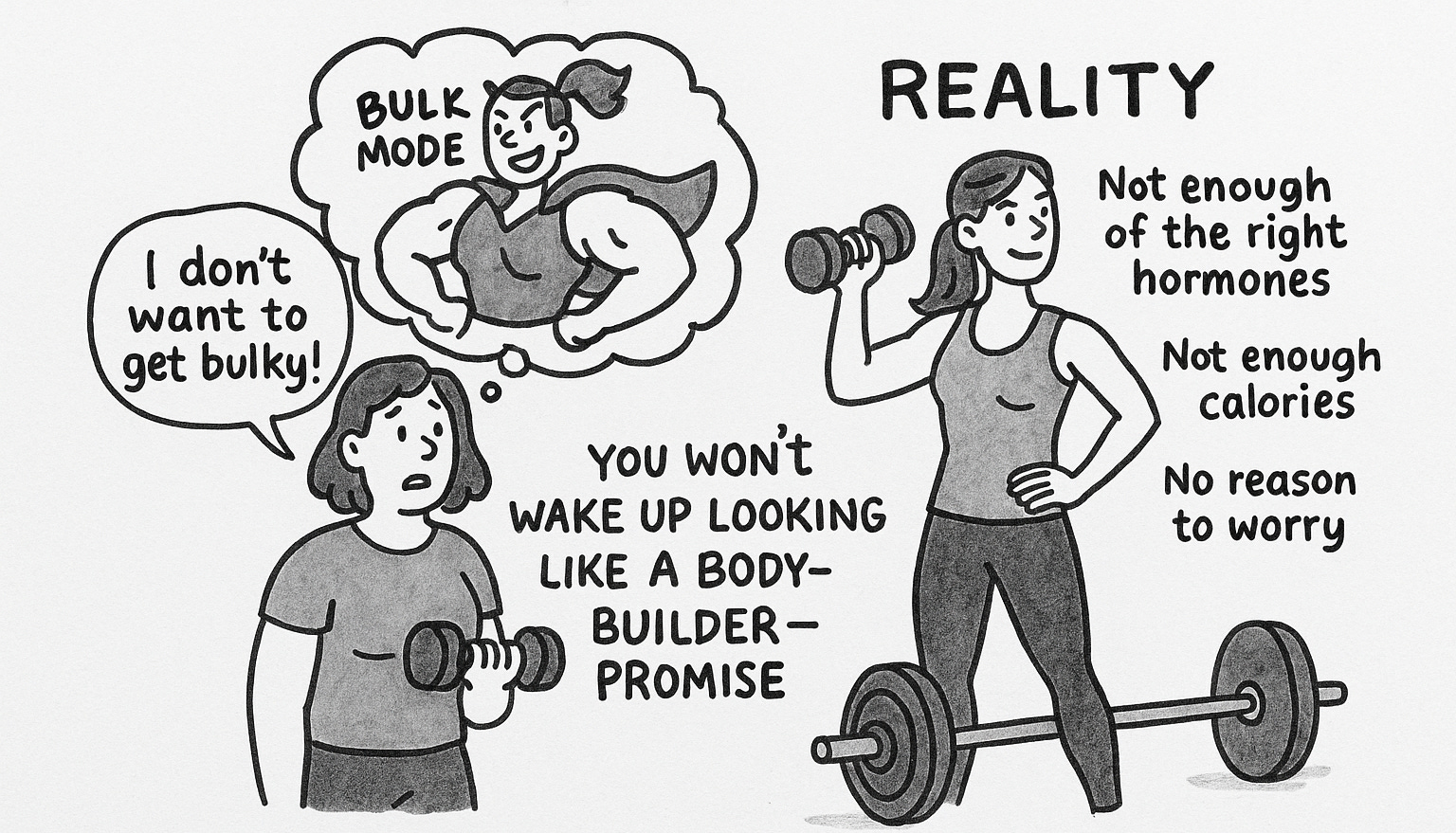
And there’s very little chance you’ll become ‘bulky.’ A bulky look comes from a combination of significant muscle growth (which takes years of high-volume training and a calorie surplus) and body fat covering the muscle. Most people who lift weights recreationally will see lean, toned muscle that improves strength and shape, not bulk. Muscle growth also depends on growth-promoting (anabolic) hormones like estrogen, testosterone, and growth hormone, all of which naturally decline with age and as part of the transition to menopause, making it even less likely that you’ll see your body inflating.
Common Questions About Protein, Answered
Plant-Based vs. Animal-Based Protein: Does It Matter?
Short answer: both work, as long as you get enough total protein. Recent research shows both omnivorous and plant-based diets can provide enough protein for weight loss and muscle maintenance with similar results when protein and calories are matched. In a recent trial, overweight people on high-protein diets lost weight and improved body composition equally well whether most protein came from animal or plant foods. The outcomes were basically the same.
What matters most is getting enough protein overall and choosing nutrient-rich sources.
Plant proteins like beans, lentils, chickpeas, tofu, tempeh, edamame, and quinoa give you protein plus fiber and other nutrients. So you’re getting more health benefits beyond just protein. They tend to be bulkier, which actually helps fill you up. On the other hand, they usually require eating larger quantities to achieve the same amount of protein, which translates to eating more calories - which matters when you’re trying to lose weight.
The trick is to balance portion sizes and health benefits while aiming for enough protein at most meals and as a total per day. The main thing with plant proteins is making sure you eat a variety of sources and that you’re getting enough.
A 2025 review confirmed that a low-calorie high-protein diet improved weight loss and metabolism regardless of whether the protein was mostly from plants or animals. Protein has the same benefits regardless of source, as long as you’re eating enough and managing total calories.
Complete and Incomplete proteins
You might have heard about some plant-based proteins being complete or incomplete. “Complete” proteins have all nine essential amino acids your body can’t make on its own and needs to consume through food. “Incomplete” proteins have some of them, but not all. Contrary to popular belief, all plants contain all 20 amino acids. However, unlike animal products, the levels of essential amino acids vary from plant to plant (some plants have very low levels of specific amino acids like lysine in grains or methionine in legumes). This means you need to eat a range of plants and an adequate quantity to ensure optimal levels of them all.
As long as you eat different protein sources throughout the day, which most of the developed world does, your body will use the building blocks it needs from whatever foods you consume.
Bottom line: eat a variety of protein sources and foods, and the distinction between complete and incomplete becomes irrelevant to how you operate day-to-day. The advice to make sure to eat rice with beans or specific pairings is no longer considered critical. As long as you eat a variety throughout your day, you’re getting all the amino acids you need. They don’t need to be eaten in pairs.
Does Timing Matter? When Should You Eat Protein?
You might have come across recommendations like “eat protein within 30 minutes of working out” or “you should spread your protein evenly with 20-30 grams per meal.” The origin of these recommendations comes from a concept known as the ‘anabolic window’ - a short period after exercise when your body is supposedly more primed to absorb nutrients and build muscle. It was previously believed that for 30-60 minutes after exercising, your muscles are more sensitive to insulin, so consuming protein and carbohydrates helps repair muscle fibers and replenish glycogen (a storage form of glucose, a carbohydrate, in your muscles and liver) more effectively.
However, the latest research actually shows that total protein intake is far more important than the precise timing of consumption.
When you eat your protein matters less than how much protein you get over the course of the day. A 2024 meta-analysis on protein supplementation in older adults found that the benefits to muscle mass did not change based on timing or frequency of protein intake, as long as total protein consumed was high enough. Whether people consumed their protein in one larger portion or spread out in smaller servings throughout the day, it didn’t significantly change muscle outcomes.
The latest thinking is that there is no “magic window” for protein consumption for weight loss or muscle maintenance. The key is maintaining an adequate supply of protein each day and having enough amino acids circulating in your blood consistently, so when you’re exercising, your body can draw on what it needs to rebuild and repair.
Your body is continuously repairing and rebuilding tissues, drawing on the amino acids available in your bloodstream. By eating protein at regular meals, you naturally keep those amino acids available for use.
The simplest strategy is to include a source of protein at each meal or major snack. This way, you stay full and give your body a steady stream of building blocks.
Why 30 Grams of Protein per Meal Matters
There is also benefit in eating a more substantial amount of protein at once, rather than drip-feeding small doses throughout the day. The idea behind eating at least 30 grams of protein in one meal is to trigger the mTOR pathway, which stimulates muscle protein synthesis (the rebuilding of muscles). The mTOR pathway is a cellular signaling system that acts like a “growth switch” in your body, telling your cells when there’s enough protein available to start building and repairing muscle tissue. Research shows that a certain “threshold” of essential amino acids, especially leucine, is needed to maximally activate mTOR. For most adults, that threshold is reached with around 25-40 grams of high-quality protein in one sitting (high quality meaning enough of the amino acid leucine, found abundantly in animal products). This is where the recommendation about at least 30 grams of protein per meal, comes from.
Studies suggest that hitting this threshold a few times per day (for example, 3-4 protein-rich meals) leads to better muscle growth and maintenance than spreading small amounts of protein evenly across many snacks.
Aiming for around 30 grams per meal helps control hunger and energy levels throughout the day and ensures you’re supporting muscle protein synthesis (the building and repairing of muscles) effectively.
But you don’t need an exact schedule, and you shouldn’t worry that the timing of consumption is hurting your progress.
Focus on the big picture: consistent daily protein intake. Hit your protein goal for the day - the timing is secondary.
How Much Protein Do You Actually Need?
One simple question, so many answers. For women over 40, experts recommend about 1.0 to 1.2 grams of protein per kilogram of body weight each day. Especially for perimenopausal and menopausal women, the recommendation is to have at least 1.2 grams of protein per kilogram of body weight. This is higher than the minimum RDA (recommended daily allowance) of 0.8 g/kg and helps accommodate the increased protein needs in midlife, when hormone levels change and your risk of muscle loss goes up (known as sarcopenia). Consuming more protein per day during this time can help offset this risk.
If you’re focused on losing weight, especially rapidly, the recommendation is to go even higher - around 1.4 g per kg per day. And if you’re losing weight rapidly with increased activity and exercise, even as high as 1.6 g per kg per day. This is especially important to adhere to if you’re losing weight at a rapid rate, for example when taking GLP-1 agonist weight loss drugs such as Wegovy, Ozempic, and others, as emerging research suggests these medications may increase muscle loss risk.
The logic behind these higher levels is to offset the risk of breaking down muscle too quickly and risking muscle loss, by providing enough building blocks to trigger muscle growth.
The more exercise you do, the more protein you’ll need to offset muscle breakdown and increase muscle building. If you’re strength training, aim for up to 1.6 g per kg per day or more. If your lifestyle is more sedentary, around 1 gram per kg per day is enough.
Protein needs vary depending on activity levels. As we exercise, our bodies need protein to repair and build muscle. The more active you are, the more your protein needs increase.
To calculate your target from pounds: divide your weight in pounds by 2.2 to get kilograms, then multiply by 1.0/1.2/1.4/1.6 as appropriate. For example, if you weigh 70 kg (154 lbs), that works out to roughly 70-112 grams of protein per day, depending on your activity level and goals.
Lastly, if you’re significantly overweight (with a BMI over 30), the recommendation is to calculate your protein requirements based on 75% of body weight - an estimation of lean body mass, your weight minus the fat. Some experts refer to this as ‘ideal body weight’ (your weight if you didn’t have any fat to lose), and calculate grams per kg per day, based on ‘ideal body weight’ not ‘current body weight’ in an attempt not to overshoot protein needs if you’re significantly overweight, by calculating them based on your existing higher number.
Don’t Stress About the Exact Numbers
Here’s something important that often gets lost in the protein conversation: the goal isn’t perfection. The goal is consistency and doing better than you were before.
If you calculate that you need 80 grams of protein per day and you’re currently eating 40 grams, getting to 60 grams is a huge win. You don’t need to hit 80 grams exactly every single day, or force yourself to eat when you’re not hungry just to meet an ideal goal number.
Prioritizing protein while balancing it with fiber, a variety of colorful vegetables, and some healthy carbs is what matters - not hitting a precise number at all costs.
Listen to your body. If you’re full and satisfied, don’t force more protein down just to meet a target. If you’re hungry an hour after a meal, maybe you would have benefited from having a bit more protein at that meal. The numbers are guidelines to help you make better choices, not rigid rules to stress over.
The research shows benefits from higher protein intake, but it also shows that adherence (your ability to stick with a way of eating long-term) is the biggest predictor of success. So find a protein intake level that works for you, that you can maintain, that keeps you satisfied and energized. That’s what will lead to lasting results.
Studies consistently show that adherence and consistency matter more for long-term outcomes than hitting an exact “optimal” protein target every day. Here’s what research shows:
Protein range, not precision
Research shows benefits for body composition, satiety, and metabolic health when you eat around 1.2-1.6 g of protein per kg of body weight per day, but being slightly below that doesn’t erase the benefits. It’s a range, not a fixed line.
The diet you can stick with wins
Studies comparing different protein levels (high versus moderate) consistently show: how well you can maintain your eating pattern matters more than hitting the “perfect” ratio. The best diet is simply the one you can actually keep up with long-term.
Small steps add up
Research on behavior change shows that gradual improvements bring real benefits, even if you never reach the “ideal” target. If you’re currently eating 40 grams of protein a day and you get up to 60 grams, you’ll see improvements in how full and satisfied you feel, how well you maintain muscle, and your energy levels - without needing to be perfect.
Sustainable always beats optimal
research on weight management consistently shows that “perfect” diets that you can’t maintain fail in the long run, every time. Being moderate, flexible, and feeling psychologically comfortable around food leads to better results for both your body and your mental wellbeing than rigidly chasing perfection.
Is There Such a Thing as Too Much Protein?
Yes there is. Not because it’s dangerous per se, but because the benefits you are getting from consuming protein above a certain point become insignificant. There’s a point where eating more doesn’t give you any additional benefits and by overloading on protein, you are leaving less room and have less appetite for other key nutrients that are important to your health (fiber, healthy fat, carbohydrates).
Research shows that the benefits for muscle building and body composition max out somewhere around 1.6-2.0 grams per kilogram of body weight per day. Beyond that, your body can only use so much protein to build and maintain muscle. The extra gets converted to energy or, if you’re eating too many calories overall, stored as fat like anything else you eat.
Studies have looked at protein intakes as high as 2.5 g/kg/day and found them safe for healthy people, but honestly, there’s not much reason to go that high unless you’re an elite athlete with very demanding training. For most of us - women in their 40s and older who are trying to lose or maintain weight, stay active, and maintain muscle - the sweet spot of 1.2-1.6 g/kg/day is more than enough. More isn’t always better. It’s about finding what works for your body, keeps you satisfied, and fits your lifestyle.
One important note: if you have existing kidney disease or other health conditions, check with your doctor before significantly increasing your protein intake. For healthy kidneys, higher protein is fine, but if there’s already an issue, your doctor may have specific recommendations for you.
Practical Tips to Meet Your Protein Needs
Understanding why protein matters is one thing - now let’s make it practical and actionable:
Include protein at every meal
Start your day with protein (eggs, Greek yogurt, a protein smoothie, or tofu scramble). It will help you feel full, prevent mid-morning energy crashes, and help stabilize your blood sugar. At lunch and dinner, make protein the center of your plate and build the rest of the meal around it with vegetables and healthy carbs. This balanced approach keeps amino acids available for your body throughout the day.
Choose protein-dense food options as your main protein source
While many foods contain protein, you want to opt for protein-dense foods as your main protein source. That way you get more bang for your buck, ingesting more protein for less volume (and calories). If you’re trying to lose weight, that balance is important.
When you’re trying to eat enough protein, you want to choose foods where protein makes up a good chunk of the calories - not just foods that happen to contain some protein. This matters because if your main protein sources are foods that have protein but also come with a lot of extra calories from fat or carbs, you’ll hit your calorie limit before you hit your protein target. And then you won’t have room left for the fiber, healthy fats, and colorful vegetables that are also important for your health.
Here’s how to figure out if a food is protein-dense: we want to know what percentage of the food’s calories come from protein. Since each gram of protein has 4 calories, you multiply the protein grams by 4 to get the calories from protein. Then divide that by the total calories and multiply by 100 to get the percentage.
But there’s a simpler way to check without doing all that math: multiply the protein grams by 10. If that number is higher than the total calories, the food is at least 40% protein, which is great - it counts as a protein-dense food.
If it’s about equal to or lower than the calories, the food isn’t particularly protein-dense. It doesn’t mean you shouldn’t eat it or that it doesn’t have great benefits for health or taste, but it’s just something to keep in mind as you’re planning your healthy meals, while trying to lose weight.

Let’s take eggs, a great option for breakfast.
One whole egg has 6 grams of protein and 70 calories.
6 x 10 = 60, which is less than 70.
So eggs contain protein, but they’re not protein-dense because a lot of those calories come from fat. If you’re aiming for 30-40 grams of protein at breakfast (which is a good target for staying full and supporting your muscles), you’d need to eat 5-7 whole eggs to get there. That’s a lot of eggs, and it’s 350-500 calories just from eggs alone, before you add anything else to your plate like fruit, vegetables, or toast.
Instead, have 2 whole eggs plus 100g of cottage cheese (or a cup of edamame, or 100g of smoked salmon). You’ll get around 30 grams of protein for about 250 calories instead of 350-500. This leaves you room to add the other things your body needs - fiber from fruit or whole grains, some healthy fats from avocado, and vegetables for vitamins and micronutrients.
Or try 2 whole eggs with 150g of Greek yogurt on the side (with berries mixed in). That’s about 28-30 grams of protein for roughly 240 calories, and you still have room for a slice of whole grain toast or some roasted vegetables.
The goal isn’t to avoid foods that aren’t super protein dense - whole eggs are nutritious, have health benefits, and most importantly taste great. It’s about building meals where you get enough protein efficiently, so you’re not using up all your calories on protein sources alone. You want a balanced plate with protein, fiber, some carbs for energy, and healthy fats - not just protein and nothing else.
Use calorie-dense protein sources as top ups. Nuts, seeds or peanut butter are part of a healthy diet, but their calories can add up. A handful of almonds has 6 grams of protein and 160 calories, mostly from fat. 85 grams of chicken breast has 25+ grams of protein and 120 calories. So while almonds provide lots of health benefits, they are not a good primary source of protein for weight loss. Use higher-calorie protein foods as accents or top-ups, rather than main sources. For example, sprinkle some pumpkin seeds over savory dishes, or add nuts to Greek yogurt. The protein they provide adds up to your daily total, but you are also getting fiber and important micronutrients at less calories overall.
Choose whole foods when you can. Getting protein from real food sources means you’re also getting iron, B vitamins, and zinc from meats, or fiber and magnesium from plants. Protein powders and supplements have their place and can definitely help you hit your targets, but they work best as backups rather than replacements for actual food.
Stay hydrated. When you increase your protein intake, bump up your water too. Your kidneys need water to flush out the waste products from protein metabolism, so keeping well hydrated matters more when you’re eating more protein.
The Bottom Line
Protein isn’t just another diet trend. It’s a fundamental building block your body needs, and getting enough becomes increasingly important as you age and start dealing with hormonal changes.
Higher protein intake helps you lose weight more effectively by keeping you fuller longer and supporting the muscle that keeps your metabolism working well. It helps ensure that the weight you lose comes from fat rather than muscle, so you end up stronger and leaner, not just smaller. And it supports your long-term health, helping you maintain strength, mobility, and independence as you age.
The science is clear: higher-protein diets lead to better fat loss and muscle retention, improvements in fullness and reductions in cravings, and they even help prevent weight regain. For perimenopausal women, paying attention to protein can ward off the subtle weight gain and muscle loss that many experience.
You don’t have to be perfect. You don’t have to follow a rigid meal schedule or eat meat to get these benefits. Just make sure you get enough total protein daily, in a form that suits your lifestyle and preferences. Make protein a priority at most meals, choose nutrient-dense sources, and pair it with strength training a few times per week.
When you understand what protein does for your body - how it keeps you satisfied, supports your muscle, and helps you burn fat rather than lose strength - making it a priority becomes obvious. Not because someone told you to, not because it’s the thing to do, but because you understand why it matters for your health, your body composition, and your quality of life.
I hope this helped bring some clarity to all the protein advice, circulating around. If you’re still wondering about something specific, let me know in the comments and I would try to address it in a future post.
I’d love to hear what clicked, what you’re planning to try, or what questions are still on your mind.
And If you found this useful, share it with a friend.