

If you’ve ever been tempted by the promise of a magic pill - something that could change your satiety signals, help you feel genuinely full, quiet that constant hum of food thoughts, and just... not want to eat as much - let me introduce you to... psyllium husk (see what I did there? :))
It’s not new. It’s not glamorous. And honestly, it tastes like you’re drinking the contents of a vacuum cleaner bag. But the science behind it is so compelling that once you understand what it does inside the body, it’s hard to imagine why it’s not getting more publicity.
What is psyllium husk?
Psyllium is the outer coating of seeds from the Plantago ovata plant. When it meets water, it forms a thick gel - similar to chia seeds, but far more absorbent. Psyllium husk absorbs 40 to 80 times its weight in liquid. That gel-forming ability is what makes it so unusual. Most fibre supplements either dissolve in water or pass through largely intact. Psyllium does something different: it creates a viscous gel that holds its structure all the way through our digestive system, from stomach to the other end. And that journey is where the magic happens.
More than a fibre supplement
Before we get to the bit I’m most excited about - satiety - it’s worth knowing that psyllium has been studied extensively across several areas of health. Its benefits have been demonstrated across dozens of clinical trials and meta-analyses. This is a highly researched compound and here are just some of its benefits.
Blood sugar - Like other soluble fibres, when we eat a meal with psyllium, the gel slows down how quickly our body can access the sugars and starches in our food. Instead of a sharp spike in blood glucose followed by a crash (which often drives that mid-afternoon slump and the hunt for something sweet), we get a gentler, more sustained rise. Research across 35 trials shows meaningful improvements in fasting blood sugar and HbA1c, particularly for people with insulin resistance or type 2 diabetes. If you’re navigating the metabolic shifts that come in our 40s, this matters. Insulin resistance becomes increasingly common, and anything that helps the body manage blood sugar more efficiently is beneficial.
Cholesterol - Psyllium binds to bile acids in our gut. Bile acids are made from cholesterol. Psyllium traps them and escorts them out through our stool, and the liver then has to pull more cholesterol from the bloodstream to make new bile acids. The end result: lower LDL cholesterol. Research across 41 trials shows reductions of around 7-10%. This is significant enough that psyllium carries an approved health claim for heart disease risk reduction in several countries.
Gut health - Psyllium is special amongst fibres because it mostly resists fermentation, so it produces very little gas. But it’s not completely non-fermented - the outer edges of the gel still get slowly broken down by bacteria. As a result, it creates less bloating than other fibre supplements and is easier to tolerate, but it still promotes the growth of beneficial species in the gut - especially the kinds known as butyrate producers. Butyrate is a short-chain fatty acid that supports gut barrier health and helps reduce inflammation.
And because psyllium holds water throughout the entire digestive tract, it normalises bowel function in both directions - softening things when they’re too firm (helping with constipation), firming things up when they’re too loose (helping with diarrhoea). No other fibre supplement reliably does both.
Hormone benefits - Our body is constantly processing and clearing oestrogen through the gut - but some of it gets recycled back into circulation instead of being excreted. That recycling can contribute to oestrogen dominance, where oestrogen levels are disproportionately high relative to progesterone. This is something many women experience in their 40s, as progesterone tends to decline earlier and more steadily than oestrogen during perimenopause. Psyllium helps with this: by binding bile acids in the gut (same mechanism as the cholesterol benefit), it essentially escorts used oestrogen out of the body rather than letting it loop back into circulation. For women in midlife, when oestrogen balance is already shifting, supporting healthy oestrogen clearance through the gut is one of those foundational things that can make a real difference.
Now, the part I find most fascinating: satiety
We know from the research on GLP-1 medications like Ozempic, Mounjaro and Wegovy that one of their most celebrated effects is reducing what people call “food noise” - that constant background chatter about food. What should I eat? When can I eat? I shouldn’t eat that. But I want it. The mental exhaustion of thinking about food all day, regardless of how hungry you actually are.
And while no study has specifically measured psyllium’s effect on food noise as such, it works on some of the same biological pathways - just at a much gentler, more modest level.
When psyllium’s gel moves through our small intestine, it triggers something called the ileal brake. Think of it as your gut’s built-in traffic control system. When food reaches the very end of your small intestine before it’s been fully digested (specifically fats, but also carbohydrates and proteins), it triggers a slow-down signal. Your stomach starts emptying more slowly, giving your body more time to absorb what’s already there. At the same time, it triggers the release of satiety hormones like GLP-1 and PYY, which send a message to your brain: we’re still working on what came in, no need to send more just yet. The result is that you feel fuller for longer, and the drive to eat quiets down.
Psyllium’s gel is particularly good at activating this mechanism because it arrives at the ileum still intact and viscous - giving the brake something substantial to respond to.
Research shows psyllium reduces hunger and decreases how much we eat at the next meal - not only by filling our stomach and absorbing water, but by triggering genuine hormonal fullness signals.
Because psyllium slows the rate at which we absorb nutrients from our meals, we also don’t get that sharp glucose spike followed by a crash. And it’s in that crash - that reactive dip in blood sugar - where so much of our between-meal hunger and cravings come from. By flattening the curve, psyllium can help keep us in a steadier state where we simply don’t feel as driven to eat.
Then there’s the gut-brain connection. When gut bacteria slowly ferment the outer layers of psyllium gel, they produce short-chain fatty acids - especially one called propionate. Research has shown that propionate can reduce how strongly our brain’s reward centres respond to high-calorie food. In brain imaging studies, people with elevated propionate found high-calorie foods less appealing and ate less at their next meal. The thinking is that this effect works through the vagus nerve - the direct communication line between our gut and our brain.
Now, let’s be honest. Psyllium is not Ozempic. While I haven’t tried GLP-1 medications, the appetite reduction from psyllium, while real, is definitely much more subtle. The research suggests around a modest 2kg reduction in body weight over several months, along with measurable decreases in waist circumference. But what people tend to report and what I’ve experienced personally, is less about dramatic appetite suppression and more about a quieter relationship with food. Fewer intrusive thoughts. Less urgency around eating. More space to actually choose what and when to eat, rather than feeling driven by hunger signals that won’t shut up. It’s a gentle boost in satiety and fullness that doesn’t prevent you from feeling hunger cues but provides a gentle helping hand when combined with healthy, nutritious eating.
It’s like the difference between sitting in a heated room and just throwing on a blanket. Things feel a little better, but you’re not boiling hot and looking to get undressed.
If you’re struggling with a mental tug-of-war with food, even a modest shift in that noise level can feel significant and help you make better, more nutritious choices and eat enough to address hunger and satisfaction, while still making it easier to deal with emotional eating or boredom snacking. Plus, since psyllium has so many other benefits beyond satiety and fullness, it’s well worth a try, regardless.
Ready to try it? Great! But...
Psyllium husk is available cheaply and conveniently at most health stores. It comes in supplement form, as fibre gummies, and as either plain powder or whole husk.
The capsules or gummies are fine for a basic level of support, but the amounts in them tend to be very small (you’d need 6-12 capsules to match what you get from a single tablespoon of the powder) and they often have additives in them, you don’t necessarily want or need. For the full health and metabolic benefits, around 5-10g a day is usually beneficial and for satiety benefits at least 10g has been quoted in research, which is hard to achieve through capsules alone.
The natural next step is to consume it in powder form, mixed with some water. But here’s the problem. In my personal and very strongly held opinion, psyllium husk, while being a highly beneficial supplement, is also one of the most revolting things you can put in your mouth.
Mixed with water, it turns into a thick, gloopy, vaguely dirt-flavoured sludge that clings to the roof of your mouth and makes you question every life choice that led you to this moment. If you don’t drink it fast enough, it thickens in the glass and becomes genuinely unswallowable. Yes, I’m aware I’m not selling this very well.
But this dual realisation, of how beneficial it is alongside how disgusting it is, is what led me to experiment with ways to incorporate psyllium into actual food. Recipes where the texture and taste work for you rather than against you.
If you’re willing to try them, at the end of this post you’ll find three of my current favourites, used on rotation. The last one has been the most impactful for me when it comes to reducing food noise and feeling more full. The difference in how full I feel and how little I think about food between meals is noticeable. Not dramatic. Noticeable. And that’s enough. I don’t even eat it daily - the effects sometimes last over a couple of days.
Three things to know before you start
Start slow - Begin with a small amount - around a teaspoon a day (or the equivalent from the recipes below: a couple of crackers, a slice or two of toast) - for a week or two before you increase. Your gut needs time to adjust. Some people experience bloating in the first week, especially if they jump straight to higher doses. Increase gradually and give your body time to adapt.
Drink plenty of water - And I mean plenty. A cup of water alongside your psyllium is not enough. You need a couple of large glasses of water throughout the day on top of what you’d normally drink. Psyllium absorbs enormous amounts of water - that’s how it works. Without enough fluid, it can actually cause problems, potentially clogging your intestines rather than moving smoothly through them. Water is non-negotiable with this one.
Watch for medication interactions - Psyllium’s gel can absorb medications and reduce how well they work (as do other fibres - they bind to the active ingredients before they are able to be absorbed into the blood and do their thing). If you take any regular medication, take your psyllium at least two hours away from it - ideally four hours for thyroid medication like levothyroxine, which is particularly sensitive to this interaction. This is a good advise for supplements as well. If you’re on medication, have a conversation with your practitioner about timing.
Lastly, if you have a diagnosed gut condition like SIBO or IBD, check with your practitioner first - though psyllium is generally better tolerated than most fibre supplements because of how slowly it ferments.
The bottom line
Psyllium husk isn’t glamorous. It won’t go viral on social media and nobody’s going to create a pastel-coloured brand around it. But the research behind it is substantial, the mechanisms are well understood, and for something that costs very little per serving, the range of benefits - blood sugar, cholesterol, gut health, and yes, helping you feel fuller and more satisfied - makes it one of the most useful tools in your toolkit.

Three recipes that make consuming psyllium husk easy:
Seeded Fibre Crackers
These are very flexible - not so much a strict recipe as a forgiving template. Play around with the quantities and your choice of seeds and spices until you find what you like.
Ingredients
2 cups mixed seeds (I use two bags of Aldi’s mixed seeds, but any combination works - sesame, flax, pumpkin, sunflower, everything goes), roughly 1 cup of each ir you are not using a premade mix.
2-3 tablespoons psyllium husk powder
Spices of your choice - I like paprika, onion powder, garlic powder, salt, and nutritional yeast, but oregano, rosemary, cumin, or anything you enjoy would work
Approximately 2.5 cups of water for 2 cups of mixed seeds (but add as much as needed to get to a spreadable consistency).
Method
Mix the seeds, psyllium husk, and spices together in a large bowl. Add the water - you want it to come up roughly to the level of the seeds. Stir well, cover with a tea towel, and leave to rest for about half an hour. The psyllium will thicken everything into a sort of paste with the seeds - not the most appetising-looking thing, but trust the process.
Line a baking tray with parchment paper and spread the mixture with a spatula into a thin, even layer, roughly 5mm thick. Bake at 150°C for one hour. Mid way through baking, after around half an hour, take the tray out and use a pizza cutter or large knife to score lines where you want to break the crackers later. Return to the oven for another 30 minutes, or until they feel firm and dry to the touch.
Let them cool completely before breaking apart. They store well in an airtight container for a week or two.
Beyond psyllium: The seeds bring their own benefits. Flaxseeds are rich in omega-3 fatty acids and lignans (which, like psyllium, support healthy oestrogen metabolism). Pumpkin seeds are a good source of magnesium and zinc. Sesame seeds provide calcium. Nutritional yeast adds B vitamins, including B12 if fortified. Together with the psyllium, you’re getting a genuinely nutrient-dense snack.
Fermented Buckwheat Bread
This one takes a bit of patience (the fermentation needs 24-48 hours), but the hands-on time is minimal and the result is a dense, satisfying, grain-free bread that toasts beautifully.
Ingredients
500g green buckwheat groats (these are the raw, unroasted kind)
1/2 cup green, black or orange lentils (or a mix of either)
1/2 cup mung beans
1/2 cup quinoa
2 tablespoons chia seeds, soaked in 1/2 cup water for 10 minutes
2 tablespoons psyllium husk powder
A pinch of salt
Water (enough to reach the level of the mixture when blending)
Add-ins: caraway seeds, pumpkin seeds, sunflower seeds, garlic powder, onion powder (to taste)
Topping: everything but the bagel seasoning and /or sesame seeds
This recipe is flexible beyond the buckwheat groats. Use whichever lentils you have around and feel free to include or leave out the quinoa and mung beans depending on what’s in your cupboard.
Method
Soak the buckwheat groats, lentils, mung beans, and quinoa together in a large bowl of water overnight, or for at least six hours. Once soaked, drain and rinse well.
Soak the chia seeds separately in half a cup of water for about ten minutes. Stir once and leave them - they’ll absorb the water and form a gel.
Add the drained grain and legume mixture, the chia gel, a pinch of salt, and enough water to reach the level of the mixture into a food processor. Blend until you have a thick, smooth batter. Add the psyllium husk and mix through.
Pour everything into a large bowl, cover with a tea towel, and leave on the worktop to ferment. Do not stir during fermentation. This takes between 24 and 48 hours depending on the warmth of your kitchen. You’re looking for a mousse-like texture - fluffy and slightly risen. Don’t worry if a skin forms on top, if it changes colour slightly, or if there’s a mild sour smell. You’ll know the batter is ready when a spoon through it feels like scooping airy mousse.
Once the batter has reached that point, fold in your add-ins: caraway seeds, pumpkin seeds, sunflower seeds, garlic and onion powder, or whatever you fancy. I sometimes add peeled macadamia nuts.
Transfer to a loaf tin lined with baking parchment and tap the tin a few times on the worktop to release any trapped air. Sprinkle the top with everything but the bagel seasoning and sesame seeds. Bake on the fan setting at 180-200°C for an hour and a half. Then carefully remove the loaf (with the parchment) from the tin and bake it upside down directly on the oven rack for a further twenty minutes.
Let the bread cool completely before slicing. I like to cut it into thin slices and freeze them, then toast a slice or two at a time whenever I want them.
Chia and Psyllium Husk Chocolate Pudding (The Fibre Bomb)
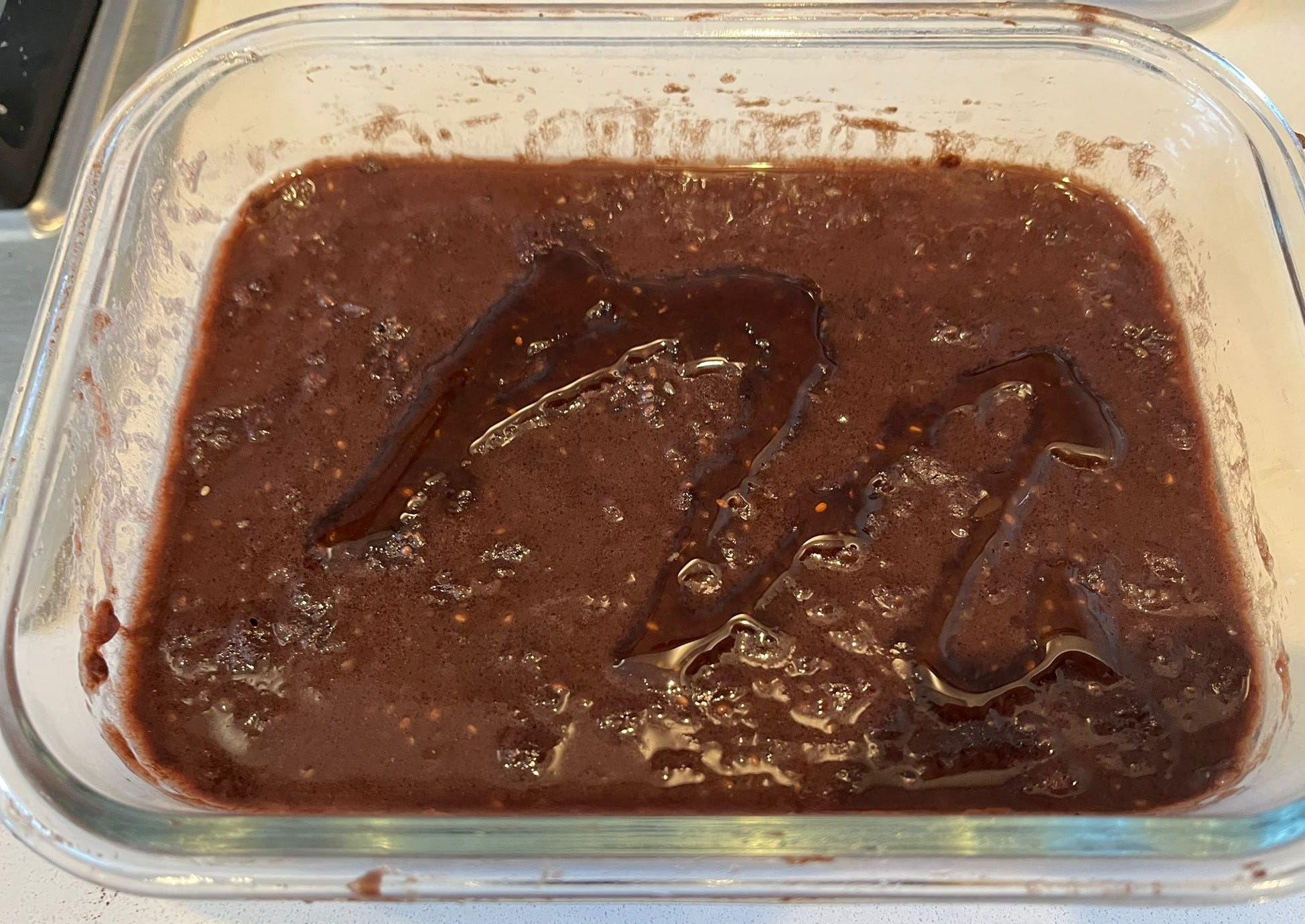
This is the one I call the fibre bomb - and it’s the one that’s made the biggest difference for me personally. It’s very high in fibre and extremely filling. I don’t eat it as a full portion in one sitting. Instead, I keep it in the fridge and take a couple of spoonfuls when I need a boost - between meals, or when I feel like snacking but know I’m not really hungry yet.
Ingredients
20g psyllium husk powder (roughly 2 heaped tablespoons)
2 tablespoons chia seeds
2 heaped tablespoons good quality cacao powder
Water (enough to fill the container - roughly 400-500ml)
1 tablespoon maple syrup, or more to taste
Method
Add the psyllium husk, chia seeds, and cacao powder to a glass container. Pour in the liquid and add the maple syrup. Stir well to break up any clumps. You can use a fork or a small whisk. A few lumps are fine and honestly unavoidable, but do your best. Pop the lid on and put it in the fridge to set for at least a couple of hours, or overnight.
What you’ll get is a thick, chocolatey, jelly-like pudding. It won’t win any beauty contests, but it tastes surprisingly decent - rich and chocolatey, with a slight chewiness from the chia seeds.
A note on quantity: this recipe makes several servings. Because it’s so fibre-dense, a couple of spoonfuls is genuinely enough to take the edge off hunger and quiet things down between meals. Start with a small amount and see how your gut responds before going in for more.
While the first two are great recipes to try and use regardless, the third is really an easy (ier?) way i found to take in psyllium husk as a supplement. A tastier way to make this would include switching water with your favourite milk, reducing the amount of psyllium husk and adding some cherries or blueberries etc. as it is written above it is more of an edible supplement.
Never heard of this before. Gathering courage to try it